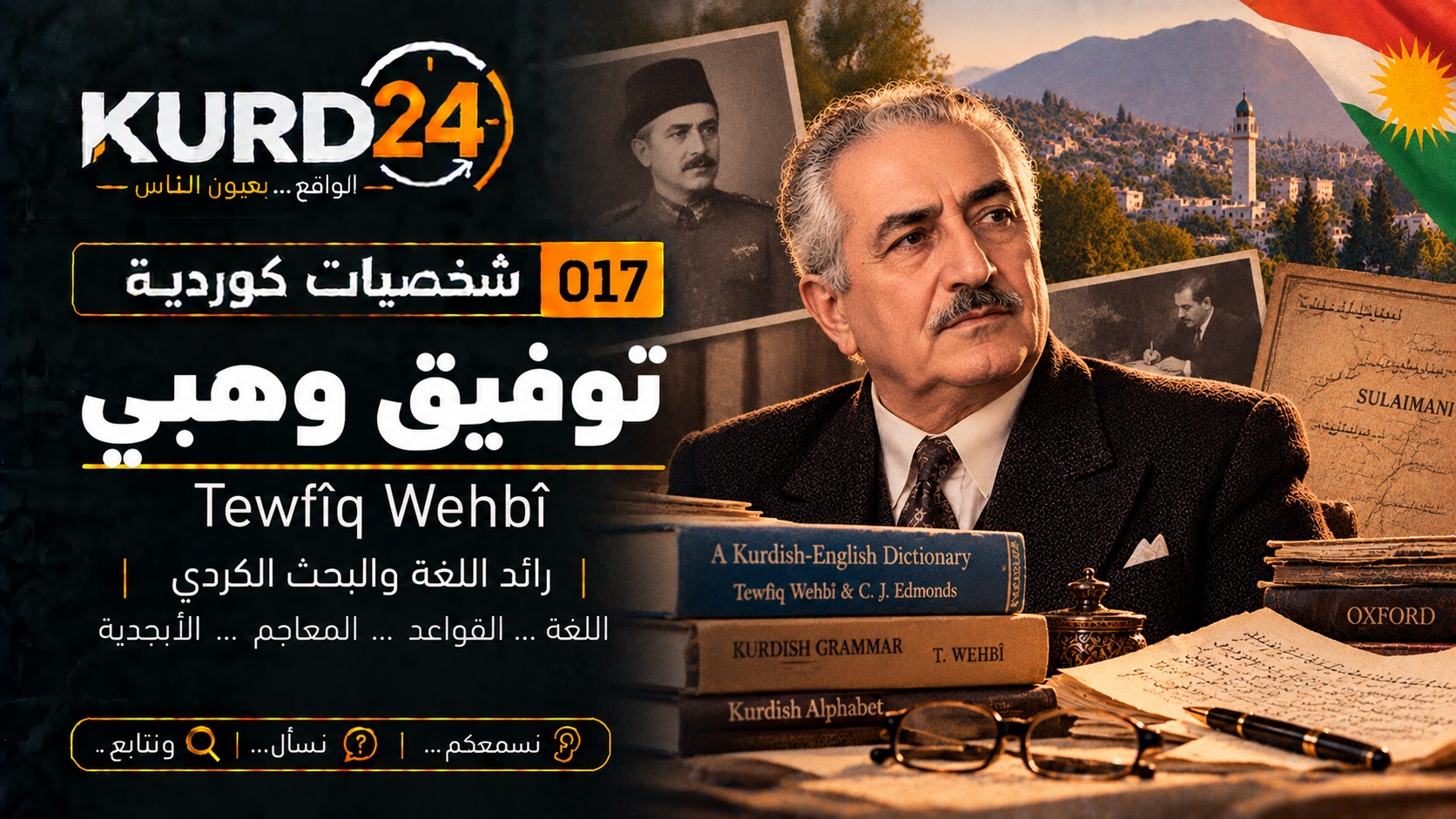
Tawfiq Wahby
Kurdish language and research
Basic information
- Full name:Tawfiq Wehbe Bey
- In Kurdish: Tewfîq Wehbî
- Birth: 1891
- Place of birth:Sulaymaniyah - Iraqi Kurdistan
- Death: 1984
- Place of death:London - United Kingdom
- Domain:Language, linguistics, dictionaries, research, education, military and political work
- The language he focused on:Kurdish, especially Sorani
- What he is most notable for:One of the most important pioneers of Kurdish linguistic studies in the twentieth century, he made early contributions to the standardization of Kurdish, reforming its writing, and trying to create a Latin alphabet for it. He also participated with the British researcher C. J. Edmonds in preparing an important Kurdish-English dictionary.
Who is Tawfiq Wehbe?
There are personalities who served Kurdish culture through poems, novels, or songs. As for Tawfiq Wehbe, he took a different path: the language itself. He was asking: How is Kurdish written? How can clear rules be set for it? How can its sounds be represented by letters? How can a dictionary be prepared that makes its vocabulary available to the student and researcher? This is why he occupies a different position than most of the previous characters in our series. He was not a poet like Ahmad Khani or Jakarkhoen, nor a singer like Hassan Zirk or Ali Mardan. He was a linguist, researcher, officer, and statesman, and at the same time lived a very complex phase in the history of Iraq and the region.
Studies related to the history of Kurdish writing indicate its prominent role in attempts to reform the Kurdish alphabet and develop Sorani writing during the first half of the twentieth century.
Starting from Sulaymaniyah
Tawfiq Wehbe was born in 1891 in Sulaymaniyah. Sulaymaniyah at that stage was one of the most important Kurdish cultural environments, and a large number of poets, intellectuals, and writers emerged from it. But Tawfiq Wehbe did not begin his career as a writer. His first path was: the army. In the late Ottoman era, he received a military education and joined the Ottoman military institutions. This background would later make him a figure that combined two seemingly distant worlds: the professional military man and the linguistic researcher.
The Ottoman officer
Wehbe studied in Ottoman military institutions and became an army officer. The Ottoman Empire was then going through its final years, while the region witnessed wars and huge national and political transformations. With the outbreak of World War I 1914–1918, Wehbe served as an officer in the Ottoman army. Thus, the man who would later sit at books and dictionaries lived in his youth the experience of the front, war, and the collapse of the empire in whose institutions he was trained. After the war everything changed. The Ottoman Empire ended, and Iraq entered a new political phase under the British Mandate and then the establishment of the Kingdom of Iraq.
Tawfiq Wehbe returned to Iraq.
New Iraq
After the establishment of the modern Iraqi state in the 1920s, Tawfiq Wahbi entered its military and administrative institutions. During his life, he held a number of military and governmental positions. This is an important point in his personality: Tawfiq Wehbe was not a researcher who lived far from the state. Rather, it was at the same time part of its institutions. That is why his biography combines: the army - administration - politics - linguistic research. This is a rare combination among the cultural figures we have discussed.
When did his interest in the Kurdish language begin?
Wehbe’s interest in language was not a late hobby after retirement. Since the 1920s, he has been one of the people who have been preoccupied with the problem: How do we write Kurdish more accurately? At that time, there was no unified writing system used by all Kurds. Kurdish writing in Iraq and Iran was mainly based on modified Arabic and Persian letters, while a Latin alphabet for Kurmanji later appeared in Syria and Turkey, especially linked to the efforts of Jaladat Badrakhan. As for Tawfiq Wehbe, he worked within the Sorani environment in Iraq.
The problem he saw in the alphabet
Kurdish contains sounds that do not exactly match Arabic. This creates a problem when we try to use the traditional Arabic alphabet as it is. Some letters may represent more than one sound, and some Kurdish sounds need special signs. Wahbi saw that writing must make the relationship between:
The sound and the letter
Clearer and more regular. From here began his experiments in reforming the alphabet.
Latin Alphabet Project
One of the projects most associated with Tawfiq Wehbe’s name is his attempt to develop: a Kurdish alphabet in Latin letters. In the late 1920s and early 1930s, he worked on a Latin system for writing Kurdish. His primary goal was to achieve a system that could accurately represent Kurdish votes. Here we must differentiate between two historical projects: Tawfiq Wehbe worked primarily in the Iraqi Sorani environment. In the 1930s, Jaladat Badrakhan developed the Latin alphabet that became primarily associated with Kurmanji, and appeared in the magazine Hawar beginning in 1932.
That is, the Kurdish Latin alphabet was not only one person’s project, but rather different attempts appeared in different regions.
Why did his alphabet not become the general alphabet?
Because the language does not change by a linguistic decision alone. There are also: schools, the state, printing presses, the press, cultural customs, and politics. In Iraqi Kurdistan, Sorani continued to develop mainly using the modified Arabic-Kurdish alphabet. In contrast, the Latin alphabet spread more widely in Kurmanji writing. Therefore, the Wahbi Latin system did not become the dominant alphabet in Iraqi Kurdistan. But the project remained important because it was one of the early and systematic attempts to reform Kurdish writing on a phonetic basis.
He did not neglect the Arabic alphabet
It is a mistake to think that Tawfiq Wehbe was only interested in Latin. He also contributed to the debate on reforming Kurdish writing in Arabic script. One of the main problems was the clear representation of Kurdish movements and voices. The modern Sorani writing that we see today uses a system greatly modified from traditional Arabic, so that each larger number of sounds has a clear representation. Wehbe was one of the pioneers of the stage of discussion and experimentation that contributed to arriving at more regular systems.
Kurdish language grammar
His goal was not only to change the letters. Rather, he also wanted to study: How does language work? That is why he wrote works on the grammar of the Kurdish language. Studying grammar is very important for any language that wants to move from daily use to: school, university, journalism, books and dictionaries. Because the language used at home can exist naturally without a grammar book. But when you want to teach thousands of students, you need clear answers: What are pronouns? How is the verb conjugated? How do tenses work? How is a sentence constructed? How are words written?
These questions were at the heart of Wehbe’s project.
He did not want to invent a new language
This is an important point. Linguistic reform does not mean creating a language from scratch. Wehbe was trying to describe the existing language and organize the way it is written and taught. That is, he started from living Kurdish speech and then tried to build scientific tools to help teach and study it. This difference is fundamental.
One of his most important projects is the Kurdish-English dictionary.
One of the works that keeps Tawfiq Wehbe’s name present until today is: A Kurdish-English Dictionary, which was prepared in conjunction with the British researcher and diplomat: C.J. Edmonds - Cecil John Edmonds. The dictionary was published by Oxford University Press in 1966. This work is one of the most famous classical lexical references for Sorani Kurdish in the twentieth century.
Who is C.J. Edmonds?
Edmunds was a British civil servant and diplomat who lived and worked in Iraq, and had extensive knowledge of the Kurdish regions and the Kurdish language. When Wehbi's experience as a Kurdish speaker and language scholar combined with Edmonds' academic and administrative knowledge, an important lexicographic project resulted. The dictionary was not just a translation of everyday words. Rather, it has become a reference for researchers, students, and translators who want to move between: Kurdish and English.
Why is the dictionary important?
Let us imagine a language that does not have enough dictionaries. If a researcher encounters an archaic or local word, where does he look? If the translator wants to know the exact meaning, what does he refer to? If a foreigner wants to learn a language, how do they start? A dictionary converts a large portion of oral knowledge into written reference. Therefore, lexical work may seem less famous than poetry, but in the construction of language it is extremely important.
Language was a science to him
Here Tawfiq Wehbe differs from some defenders of the language who deal with it only emotionally. For him, loving language is not enough. You should: study their sounds. Determine its rules. Gather her vocabulary. Establish a system for writing it. And make tools to teach it. That is why his project can be described as a project: transforming language into a subject of systematic study.
His interest did not stop at language
Tawfiq Wehbe had wide interests. He also wrote and researched topics related to: Kurdish history, culture, heritage, geography and the origins of some names and locations. He was also interested in studies related to the ancient history of the region. Here, a distinction must be made between two things: some of his historical ideas belong to the level of research available in his time, and some of the hypotheses that were circulating in Kurdish and European studies during the twentieth century no longer necessarily represent the modern academic consensus. This is normal for a researcher who lived decades ago.
Therefore, his primary importance remains: his leadership in research, and not the necessity of the validity of every historical hypothesis he wrote.
Tawfiq Wehbe and Iraqi politics
His public career did not stop with the army. Wahbi entered political and administrative life in the Kingdom of Iraq and held government and ministerial positions at various stages. This stage places it within a complex political context, in which the Kingdom of Iraq witnessed internal conflicts and repeated government changes. Therefore, it is better to read his political role separately from evaluating his linguistic achievement: the linguistic researcher is one thing, and the government official and his political positions are another. The two may come together in the same person without one being automatically evidence of the other.
A minister... and a researcher at the same time
What is interesting is that government work did not cancel his interest in the language. Continue writing, researching, and communicating with orientalists and researchers. This made his life move along two parallel lines: the first line was the army, the state, and politics. Kurdish second line, grammar, alphabet and glossary. In the end, the second line is the one that remains most present in cultural memory.
London
Tawfiq Wehbe spent an important part of his later years in London. His presence in Britain was also important for his relationship with institutions and researchers interested in Kurdish and Middle Eastern studies. In that environment, his scientific and cultural activity continued. He also contributed to supporting institutions concerned with Kurdish culture and studies in Europe.
The Kurdish Institute in Paris
There is another important aspect of his legacy. Tawfiq Wehbe was one of the figures associated with the founding of the Kurdish Institute in Paris in the early 1980s. The institute, which was founded in 1983, later became one of the most important European institutions specialized in: Kurdish culture, language, books, archives, studies and seminars. The presence of a figure from his generation in this project demonstrates that his interest in language continued until his final years.
Between Wahbi, Jakarkhwain, and Hajar
In the last three episodes, we have a very beautiful cultural line: 014 - Jakarkhoen used the language in poetry, and wrote a grammar and a dictionary as well. 015 - Hajar used it in poetry, translation, and dictionary. 017 - Tawfiq Wehbe focused mainly on grammar, the alphabet, the dictionary, and linguistic study. All three served the language, but each one in its own way. Jakarkhoen made her a social and poetic voice. Hjar transfers heritage between languages and dialects. As for Tawfiq Wehbe, he tried to give her: tools for organization, education, and study.
Sorani in his project
Wehbe’s works are particularly linked to: Sorani Kurdish. This is an important point in the context of the history of the language. During the twentieth century, Kurmanji and Sorani developed partly different writing traditions. In Kurmanji, the Latin alphabet associated with the Hawar school became widespread. As for Sorani, especially in Iraq and Iran, it basically continued with the Kurdish alphabet based on the modified Arabic letter. Wehbe’s work falls at the heart of the stage in which these systems were being discussed, developed, and enacted.
Why is the alphabet important for cultural identity?
Because writing determines the ability of language to move through time. The sound disappears. As for the text, it remains. If you have a clear alphabet you can: Print a book. You open a school. Make a dictionary. You write a newspaper. Memorize a poem. Translate science. Therefore, Wehbe's discussions about letters were not a small technical issue. It was related to the larger question: How does Kurdish become a modern language of teaching and writing?
His relationship with orientalists and researchers
Tawfiq Wehbe lived in a period when a large portion of the academic studies written about Kurdish in European universities came from orientalists and foreign researchers. But he was different from them in one fundamental point: Kurdish was his language and culture. This gave him internal knowledge of vocabulary, pronunciation, and social usage that an outside researcher does not easily possess. In turn, collaboration with scholars such as Edmunds gave him access to European academic research, dictionary and publishing traditions. Hence the importance of cooperation between the two parties.
Was Tawfiq Wehbe a writer?
Yes in a broad sense, but he is not primarily known as a poet or novelist. Its major position comes from: linguistics - grammar - dictionaries - the alphabet - research. Therefore, describing him in the episode’s design as “a pioneer of the Kurdish language and research” is more accurate than describing him as just a “poet” or “writer.”
Long years of transformations
When we look at his life chronologically, we find something remarkable. He was born in 1891 during the Ottoman era. Witnessed World War I. Witnessed the collapse of the Ottoman Empire. Witnessed the founding of the Iraqi Kingdom. He worked in the army and the state. He witnessed the expansion of journalism, radio, and modern education. He participated in projects to modernize Kurdish writing. Then he lived until the era of modern European universities and cultural institutes. That is, his life spanned almost an entire century of transition from empire to modern state and from manuscript to printed academic dictionary.
His death
Tawfiq Wehbe died in 1984 in London, after a life of nearly ninety-three years. It is noteworthy that the year of his death is the same as the year of the death of the character of episode 014, Jakarkhoen. But the two men took very different paths. Jakarkhoen made Kurdish poem reach the people. As for Wahbi, he tried to make it a system that could be studied, written, and taught.
What remains of Tawfiq Wehbe?
His books remain. And his dictionary remained. Studies related to his project remained in the alphabet. But his most important legacy may be a broader idea: language needs institutions and tools, not just speakers. If a language is to survive in the modern world, it needs: a school, a grammar, an alphabet, a dictionary, a printing press, researchers and a university. Tawfiq Wehbe spent a large part of his life working on these tools.
Why do we remember Tawfiq Wehbe?
Because it represents an aspect that does not always get the fame that a poet or singer gets. The poet leaves a poem that people can memorize. The singer leaves a song that can be heard by millions. The linguist leaves behind something less visible but profoundly influential: the tools that allow others to write, read, and learn. Tawfiq Wehbe studied Kurdish sounds. Written in its rules. Try to fix her alphabet. Try Latin letters. He participated in developing studies related to Sorani writing. With C.J. Edmonds, he prepared one of the most famous Kurdish-English dictionaries of the twentieth century.
At the same time, he lived a life completely different from the image of the isolated researcher: he was a former Ottoman officer, an official in the Iraqi state, a minister, a researcher and an intellectual. Therefore, his biography is not only the story of a linguist. It is the story of a man who lived the transition from the Ottoman Empire to modern Iraq, and from traditional education to linguistic research and modern cultural institutions. At the heart of all of this, one question remains: How do we write Kurdish and preserve it for future generations?