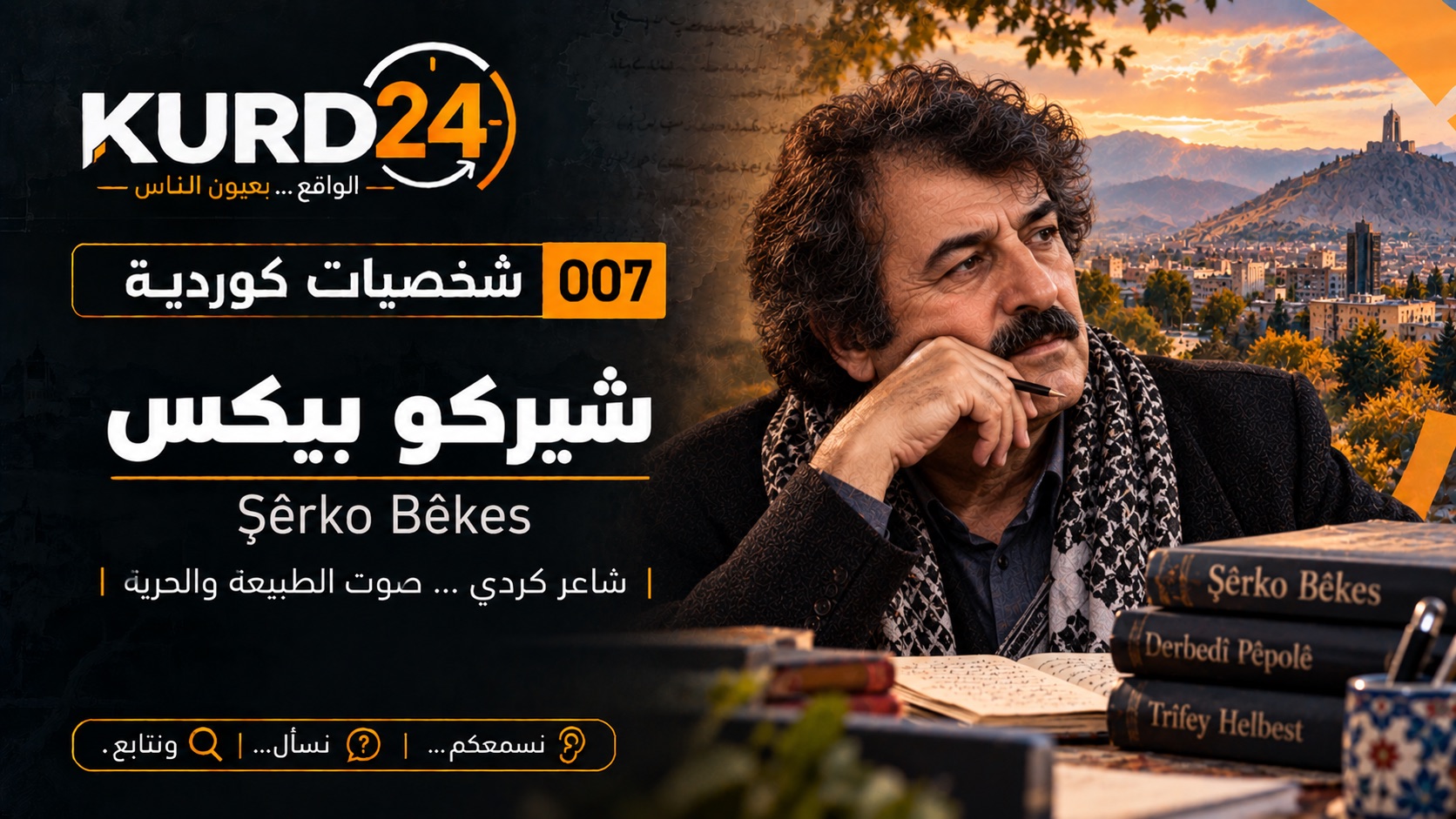
Sherko Bekas
Poetry and modern literature
Basic information
- Name:Sherko Bêkes – Şêrko Bêkes
- Birth:May 2, 1940 - Sulaymaniyah
- Death:August 4, 2013 – Stockholm
- Domain:Poetry, literature and culture
- Writing language:Sorani Kurdish
- His father:The poet Faiq Bix
- What he is most notable for:Renewal of modern Kurdish poetry and its images linked to nature, freedom and exile
Who is Sherco Pix?
Sherko Bex is a Kurdish poet from Sulaymaniyah whose experience spans more than half a century. He knew cultural and radio work, life in the mountains, house arrest, and exile in Sweden, then returning to Kurdistan and assuming the Ministry of Culture for a short period. Poetry remained the focus of his career.
His birth and beginnings
He was born in Sulaymaniyah on May 2, 1940, and his father, Faiq Bix, was a Kurdish poet. He began writing poetry when he was about seventeen, and published early poems in Kurdish newspapers and magazines. His collection “Trîfey Helbest” was published in 1968, according to lists of his works.
Renewal of Kurdish poetry
His name was associated with the literary renewal movement “Rûwange” in the early seventies. The Kurdish Institute in Paris states that its group “Rûwange” appeared around 1970 and contributed to transcending some traditional meters and rhymes. He was interested in the poetic image, the free poem, and the relationship between nature and man.
Nature and freedom
In his poetry, a tree, flower, window, or stone may turn into a carrier of human or political meaning. Nature was not just a backdrop; He used the mountain, rain, river, and birds to express homeland, freedom, fear, war, and exile. He also wrote about love, memory and everyday life.
From the poem to the mountains
He joined the Kurdish movement in Iraq in the sixties, and worked on its radio and in cultural journalism. With the return of fighting in the 1970s, he was forced to work secretly. After the events of 1975, he returned to Sulaymaniyah, then was placed under house arrest in western Iraq, but he continued writing.
Return to the mountains and then exile
He returned to the Kurdish movement areas in the mountains in 1984, and participated in radio and cultural activity. Then he settled in Sweden in 1987. Exile became an important topic in his poems, and Kurdistan, with its mountains, villages, and events, remained present in his writing despite the geographical distance.
War and Halabja in his poetry
The war and the events of Anfal and Halabja left an impact on his work. One of the texts linked to the memory of this stage is his long poem “Valley of the Butterflies - Derbendî Pepûle.” He combined images of nature, destruction, and nostalgia, and transformed tragedy into a poetic language based on image and symbol.
Return to Kurdistan
He returned after the transformations of 1991, and was appointed Minister of Culture in the first government of the Kurdistan Region in 1992. His government experience was short, and then he returned to writing and cultural work. He was also associated with publishing institutions and initiatives in Sulaymaniyah.
Its production and spread
He published collections and long poems over the decades. Selections of his poetry have been translated into Arabic, English, Swedish, French and other languages, allowing his experience to reach readers outside the Kurdish language. The presence of nature, freedom, exile, war and love is repeated in his works.
His death and legacy
He died in Stockholm on August 4, 2013 after falling ill, and his body was returned to Sulaymaniyah, where he was buried in Azadi Park. His name remains associated with the renewal of modern Kurdish poetry and with his ability to express the experiences of Kurdistan through poetic images and nature.
Why do we remember him?
Because he was one of the poets who expanded the styles of modern Kurdish poetry, and transformed the events of war, exile, oppression, and nostalgia into a literary world whose impact remained present after his departure.