
Qadri Jan
Poetry, literature and journalism
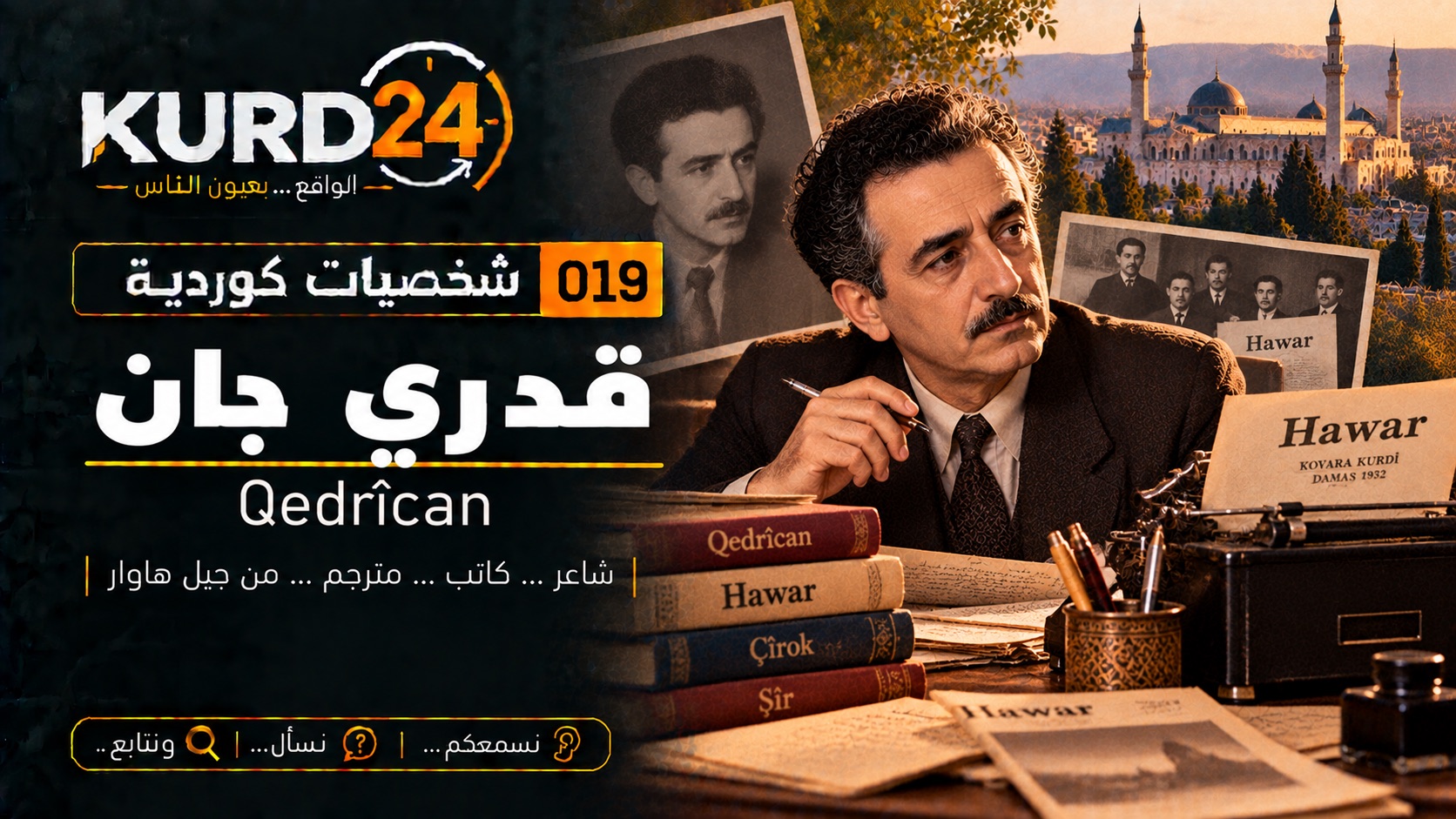
Basic information
- Original name:Abdulkadir Jan - Abdulkadir Can
- Literary name:Qadri Can - Qedrîcan
- Birth: 1911
- Place of birth:Derik - Derik, in the Mardin region, within the Ottoman Empire at the time
- Death:August 9, 1972
- Place of death:Damascus - Syria
- Age:About 61 years old
- Domain:Poetry, story, article, translation and education
- Basic writing language:Kurdish - Kurmanji
- What he is most notable for:One of the pioneers of innovation in Kurmanji Kurdish poetry in the twentieth century, and one of the most prominent writers in the literary environment that formed around Hawar magazine.
Who is Kadri Can?
If we want to understand the importance of Kadri Can, we have to put him in the moment in which he lived. It did not appear at a time when Kurdish literature had a wide network of publishing houses, universities and magazines. Rather, he lived in a period in which Kurdish intellectuals were trying to build modern, written Kurdish literature in difficult circumstances, while many of them were living outside their original homeland. In that environment, a generation emerged that was associated with names such as: Jaladat Badrakhan, Kamiran Badrakhan, Jakarkhwain, Othman Sabri and Qadri Can. Magazines such as Hawar and Ronahî have become essential platforms for publishing Kurmanji in Latin script, and for publishing poetry, stories, and articles.
Qadri Jan was one of the voices that contributed to this transformation. Its importance does not come from poetry alone. He wrote: poetry, short stories, articles and translations. Therefore, he can be viewed as part of the generation that contributed to the transfer of Kurmanji Kurdish literature from a stage dominated by classical poetry and oral heritage to a modern literature that uses journalism, stories, and new poetry.
The beginning is with Derek
Abdul Qadir Can was born in 1911 in Derik, located today within the state of Mardin in southeastern Türkiye. Sources mention that his father was known as Cano - Janu, and hence the name Can/Jan was associated with him. Wikipedia He grew up in a period of great turmoil. He was about three years old when World War I began. Then his childhood witnessed the collapse of the Ottoman Empire, the wars that followed, and the emergence of the modern Turkish Republic. That is, Kadri Can did not know a stable world since his childhood. Borders, countries, politics and identities were changing around him.
These transformations would appear later, directly or indirectly, in his literary world.
His father chose education for him
His biography states that his father insisted on educating him at a stage when formal education was not widely available in his environment. Abdul Qadir showed academic excellence, especially in science and mathematics. That's why his father sent him to Konya to continue his studies at a teacher training school. Wikipedia This information is important. Because when we read his poetry later, we may imagine him as a man of letters from the beginning. But his formal education was linked to a profession: teaching. Education will remain present in his life after moving to Syria.
From Konya to exile
During his younger years, the political situation in Türkiye became more sensitive towards Kurdish activity. The sources link Qadri Can's move from Türkiye to Syria to the political climate that followed Sheikh Saeed's revolution in 1925, and mention that he was persecuted or became the subject of suspicion because of his activity and writing in Kurdish. Wikipedia, but some precise details about the circumstances of his exit differ between published biographies. Therefore, it is more accurate not to turn it into one definitive story. What is certain about his life's path is that he left Turkey and settled in Syria, and Damascus became a major center for his later cultural life.
And from here begins the most important chapter in his story.
Damascus... the exile that became a cultural center
For Kadri Can, Syria was not just a place of residence. In the 1920s and 1930s, Syria and Lebanon became a place of activity for a number of Kurdish intellectuals coming from Türkiye. There, Qadri Can met a cultural environment that would change the history of modern Kurdish literature. In her heart was: Celadet Ali Bedirxan. In this environment, Hawar magazine appeared, which began publishing in Damascus in 1932.
What is the importance of Hawar?
To understand Qadri Jan, we must understand Hawar. It wasn't just a news magazine. It was a linguistic, cultural and literary project. Published: poetry, stories, linguistic studies, folklore, translations and articles. It was also associated with the dissemination and stabilization of the Latin alphabet of Kurmanji, which was developed by Jaladat Badrakhan. Over time, Hawar became one of the central stations in the history of modern Kurdish Kurmanji literature. Qadri Jan was one of the writers whose works appeared on its pages from its beginnings.
Qadri Jan and Jill Hawar
This generation is very important in our series. Because when we discussed Ahmet Khani - 001, we were talking about classical Kurdish literature. When we arrived at Jakarkhoen-014, we clearly began to enter modern Kurdish literature. As for Qadri Can, he is at the heart of the transitional phase in which: literature + journalism + the modern alphabet became part of a single cultural project. For these writers, the magazine was a publishing house, a literary school, and a cultural platform at the same time.
He was not only a poet
This is a very important point in introducing his character. Kadri Can is often remembered as a poet. But he also wrote: the short story. This increases its importance in the history of modern Kurdish literature. A story needs a different structure than a poem: characters. It happened. a dialogue. place. time. And a struggle. Published catalogs of his works show a large collection of stories and prose texts that appeared in Hawar, Ronahî, and others. “Guneh - Guneh/The Sin” One of the works associated with his name is the story: Guneh, meaning “the sin.” It appeared in Hawar, and was later republished in collections of his works.
What is noteworthy is that not all of Qadri Jan’s works were collected into independent books during his lifetime. This was common among writers of his generation. The magazine was the primary venue for publication. Therefore, a large part of his production remained distributed between: Hawar - Ronahî - Roja Nû, and then later researchers and publishers came to collect these texts.
What was written in Hawar?
Archival lists of his works give us a clear idea of his activity. Among the published texts and stories attributed to him, we find titles such as: Gundê Nû Ava Silêman Bedirxan Hêviya çarde şevî Gelo newisan Tabûta bi xwînê Bihara Dêrikê Guneh Rojên Derbasbûyî Sond, in addition to other texts that appeared in Ronahî. This list is important because it reveals that the man was as productive in prose as he was in poetry.
Qadri Jan and modern poetry
Here we reach the most important literary aspect of his personality. Kurdish literary sources describe him as one of the pioneers of modern Kurdish poetry, especially the experiments that moved away from strict adherence to traditional meters and moved towards free poetry. This is a major point in the history of Kurdish poetry. Kurdish classical poetry, like much of the region's literature, was linked to specific meters and templates. But the twentieth century brought with it: the city, the press, social movements, European and Russian literature, wars and revolutions. Some poets began searching for a form that could express this new world.
Qadri Jan was one of them.
From metered poetry to free verse
What is meant by free poetry here is not that the poet writes without any structure. Indeed, it is no longer always bound by the same traditional template: number of verses, fixed meter and regular rhyme. The rhythm of sentence, image and idea became freer. This allowed the poet to talk about: the city. The worker. The farmer. the prison. War. Exile. Freedom. And social issues. In more direct language. Sources about Qadri Can link his poetic style to being influenced by the climate, as represented by poets such as Vladimir Mayakovsky and Nazim Hikmet, with the need to deal with the degree of this influence as a critical reading and not a direct discipleship relationship. Bernamegeh
Early poems
The indexes show that Qadri Can published in Hawar between 1932 and 1933 poems with titles including: Tabûta bi xwînê Berdêlk Hesinker Di Şorezarekêda Cegerxwîn Xewna hişyartî Dadê. The presence of these texts in the first issues of Hawar confirms that he did not join the project after its success. Rather, it existed at a very early stage in the formation of this literary community. “Cegerxwîn” One of the most beautiful details in the series is that one of Kadri Can’s poems published in Hawar in 1933 is titled: Cegerxwîn. Jakarkhoen himself is character number:
014 in our series. This shows how our characters were not separate islands. Some of them knew each other. He writes about each other. Published in the same journals. It participates in shaping the cultural environment itself.
Themes of his poetry
The poetic world of Qadri Jan can be summarized in a set of themes that are repeated in readings of his works: Homeland and exile He left the place where he was born and lived a large part of his life in Syria. Therefore, place, nostalgia, and belonging become natural themes in his literature. Freedom He lived in a time when politics was strongly present in the life of the Kurdish intellectual. Social Justice In his poetry and prose, there is a clear sensitivity to poverty, social classes, and the common person. Love and Nature His poetry was not only political. Nature, women, emotion, the village, and spring also appear in his texts.
Man, and this is perhaps the broader point. Qadri Jan did not write about identity in isolation from human social issues.
His intellectual orientations
Biography sources describe Qadri Can as being influenced by the socialist and internationalist ideas that were widespread among a number of twentieth-century intellectuals, and this tendency appears in many readings of his poetry. Bernamegeh Here it is important to differentiate between:
His literary biography
And he explained: the political position on his ideas. For our project, what is most important is that these ideas were part of the environment that shaped his literature, just as nationalism, socialism, anti-colonialism, and other trends influenced many writers in the Middle East and Europe during the twentieth century.
Trip to Moscow
His biography sources also mention an important trip to Moscow linked to an international youth conference. The sources say that he communicated with the Kurdish researcher Qanatê Kurdo, and that the trip put him in contact with an academic environment in which Kurdish studies were active, especially in the Soviet Union. Bernamegeh This trip is linked to a poem entitled: Ez diçim Mosko “I am going to Moscow.” The biography states that he passed through Istanbul and Odessa on his way to Moscow. Bernamegeh, but the details of this trip and its precise date are less documented than the information about his birth and publication in Hawar, so it is better to present it as part of the novels and biographies published about him, not considering all its details settled.
The teacher
There is another aspect that should not be lost in the midst of poetry and politics: Kadri Can was a teacher. Sources state that he was known for teaching Kurdish, including his educational activity in Syria. Justice for Kurds This fits perfectly with his early educational background in Konya. For the man who entered the teacher training school in his youth, an idea remained:
Transfer of knowledge
part of his life. In the case of a language for which formal learning opportunities are limited, education itself becomes part of the preservation process.
Translation
Qadri Jan also worked in: translation. This is an important aspect of the Hawar generation in general. The cultural project did not just want to republish the ancient Kurdish heritage. He also wanted to bring Kurdish literature into dialogue with: Turkish, Arabic, French, Russian and world literatures. Translation is one of the primary ways to do this. That is why his biography is usually described in three adjacent roles: poet - writer - translator.
Why did he not publish dozens of books under his name?
Someone might ask: If Kadri Can was so important, where is his large library? The answer is related to the way his generation worked. In the first half of the twentieth century, there was no stable Kurdish publishing structure that could transform the production of each writer into a collection of books. Therefore, publishing in: magazines and newspapers was essential. Qadri Jan’s production remained distributed among the issues of periodicals. This is why the process of collecting his works into books came more widely after his death. Today there are collections collecting his stories, articles, poems and translations.
Qadri Jan and Jaladat Badrakhan
The cultural relationship between Qadri Jan and Badrakhan’s environment is fundamental to understanding it. Jaladat Badrakhan was not just a magazine publisher. He worked on: the alphabet, grammar, language, journalism and literature. Hawar provided a space in which a writer like Kadri Jan could write Kurmanji in the new Latin alphabet and reach readers outside his village and city. Thus, three elements met: the new alphabet, the magazine, the new generation of writers, and from this meeting a large part of modern Kurmanji literature emerged.
From Ahmed Khani to Qadri Can
If we look at the Cord 24 series that we have built so far, we can see a beautiful historical path. Ahmed Khani - 001 represents one of the pinnacles of classic Kurdish literature. Mahmoud Bayazidi - 018 represents an important stage in the codification of Kurmanji prose, tales and folklore in the nineteenth century. Kadri Can - 019 represents the transition to: the modern magazine + the short story + the new poetry. This means that the three characters, although they did not live in the same era, help us see the development of Kurdish literature over the centuries.
His relationship with Jakarkhoen
Qadri Can and Çekerkhoen were part of the Kurdish cultural milieu in Syria. But their experiences are not copies of each other. Jakarkhoen was strongly associated with social and political poetry, with his own style, and with a wide-ranging poetic production that spanned decades. As for Qadri Can, he also distinguished himself through: stories, prose, translation, and literary journalism. Most importantly, both of them benefited from the platforms provided by the Kurdish cultural movement in Syria.
Damascus... the second city in his life
He was born in Derrick. But Damascus became the main city in his later life. There he lived. There are books. There he met intellectuals. From there, his texts were released to readers through magazines. In Damascus, his life also ended. Archival sources specify the date of his death as: August 9, 1972. Kurdish sources state that he was buried in Damascus in a cemetery associated with the name of Sheikh Khaled Al-Naqshbandi. He was about 61 years old.
What's left of it?
Kadri Can did not leave a huge monument or institution bearing his name globally. But he left out something more widespread within literature: texts. His poems. His stories. His articles. His translations. And his works published in the pages of Hawar, Ronahî, and Roja Nû. His name remained associated especially with the generation that helped establish modern Kurmanji Kurdish literature written in Latin letters.
Why do we remember Kadri Can?
Because the history of literature does not change only when a great poet appears. It also changes when you change: the way you write. Place of publication. The form of the poem. The language of the story. Reader type. Qadri Jan lived at the meeting point of all these transformations. He was born in the late Ottoman era. He studied to become a teacher. He left his homeland and settled in Syria. He entered the Kurdish cultural community in Damascus. He has written for Hawar since its early years. Try modern poetry. Short story books. He worked in translation and education. He made Kurmanji a language in which he could write about: love, homeland, poverty, freedom, exile and modern man.
Therefore, its importance does not lie in just one text. Rather, he was part of the generation that practically said: Kurdish can be the language of modern literature.