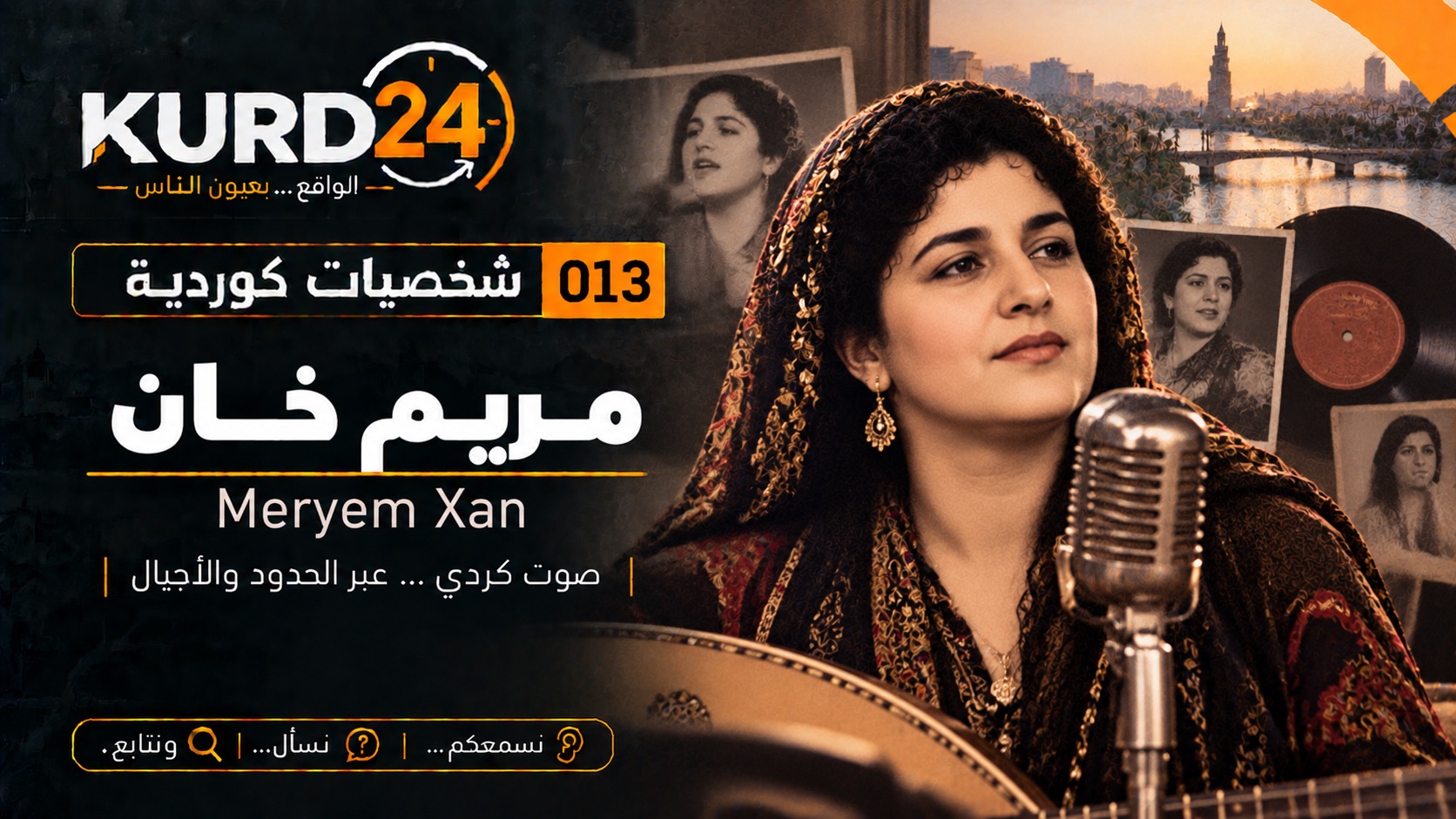
Meryem Xan
Kurdish singing and music
Basic information
- Name:Maryam Khan – Meryem Xan / Meyrem Xan
- In Kurdish:Mereham Khan
- Birth: 1904
- Place of birth:Sources suggest that the village of Dêrgolê / Dêrgûlê is in the Şırnak district, within the historical domain of Bhutan.
- Death:1949 – Baghdad, Iraq
- Domain:Singing, dongbeg, and Kurdish folk music
- Lyrical language:Kurdish - Kurmanji
- What she is most known for:One of the first and most famous Kurdish women whose voice reached commercial recordings and radio, and several sources describe her as the first Kurdish woman whose singing was recorded on records.
Who is Maryam Khan?
Before radio and recordings became an essential part of Kurdish music, song was transmitted mainly by voice and memory. The Dengbeg memorizes the song, performs it in front of people, and then it is passed on to another Dengbeg and to another generation. In the first half of the twentieth century, recording technology and radio entered this equation. This is where the name Maryam Khan appears. She became one of the most prominent Kurdish female voices at that stage, and her voice reached CDs and then on Baghdad Radio, at a time when the public artistic field, especially professional singing, was much more difficult for women.
That is why her importance is not limited to the beauty of her voice or her songs; Rather, she is also associated with being one of the women who transferred the Kurdish women's voice from the private sphere to recording, radio, and the wide public.
Birth in the Bhutan region
The most widely circulated sources place her birth in 1904 in a village called Dêrgolê or Dêrgûlê, in the current Şırnak region in southeastern Turkey, within the historical and cultural sphere known as Botan. semakurd.net Some biographies mention that her father was called: Mihemed Ehmedê Botî – Muhammad Ahmed Al-Bouti. The area in which I grew up was rich in traditions of oral storytelling and song, an environment in which the Dengbeg flourished. This heritage will be the basis of her artistic experience.
What is Dingbeg?
To understand Maryam Khan, one must understand the word Dengbêj. Dengbij is not just a singer in the modern sense. He is a storyteller, singer, and oral memory keeper; Through his voice, he conveys stories of love, separation, wars, migration, heroism, family tragedies, and historical events. For centuries, this art was an essential means of preserving a large part of the Kurdish heritage before the spread of popular recording and writing. Maryam Khan grew up within this singing world, and became one of the most prominent women associated with it in the twentieth century.
War and Migration
Maryam Khan’s childhood coincided with one of the most turbulent periods in the region’s history. The First World War and the accompanying unrest and population changes had a severe impact on the border areas. Several sources mention that her family left their homeland during this stage and moved to the Kurdish regions in Syria, with Qamishli and Damascus mentioned in accounts of her biography. Thus, she entered immigration early in her life. Later, her life would become a long series of moves: Bhutan → Syria → Zakho → Mosul → Baghdad. However, the order and dates of some stations differ slightly between sources.
Marriage and Badrakhan’s family
One of the most famous accounts related to her life says that during her time in Syria, she met members of the well-known Kurdish Badrakhan family, and married a man from this family. The story says that the problem arose when she wanted to continue singing. Her husband was not comfortable with her appearing as a singer and dongbig in front of the public, and she had to choose between married life and her artistic career. So she chose art and the marriage ended. This story is mentioned in more than one source, but the details of the husband’s name and the circumstances of the marriage and separation are not identical, so it is best to treat it as a famous part of her biography supported by several accounts, with different details.
A woman singing in front of an audience in the 1920s and 1930s
This point is very important. Today a woman's decision to become a singer may seem relatively normal, but Maryam Khan's social environment in the 1920s and 1930s was different. The public art of dingbig was dominated by men, and women who wanted to sing professionally in front of an audience faced great social restrictions. Studies on women's danbag indicate that Maryam Khan's experience, and later Ayesha Shan's experience, reveal the amount of conflict some women faced due to the choice to sing publicly. Biblio
This makes her career more than a musical story. It is also the story of a woman who insisted on having a public voice in a society that did not easily give women the same space.
To Zakho
One biography mentions that she moved to Zakho in 1924, and stayed there for years before moving to Mosul. Zakho is located at an important geographical point close to the current borders between Iraq, Turkey and Syria. For an artist carrying Bhutanese singing traditions, this region was part of an interconnected cultural space despite modern political borders. From Zakho, her journey continued south.
Mosul, then Baghdad
According to the recurring narrative in her biography, Maryam Khan moved to Mosul around 1936, and from there to Baghdad. Moving to Baghdad was the most important turning point in her artistic life. Baghdad was not just a big city. It was a center for the radio, record and music industry in Iraq, and Maryam Khan was able to move from singing within the local environment to professional recording and radio broadcasting.
Baghdad... the moment when everything changed
In Baghdad, Maryam Khan met Kurdish artists and singers, a number of whom later became important names in the history of Kurdish music. The sources mention names such as: Muhammad Arif Al-Jazrawî - Mihemed Arif Cizrawî Ali Mardan - Elî Merdan and a number of artists coming from different Kurdish regions. This artistic milieu was different from village life and traditional Dengbeg. Here there are: microphones, bands, studios, records, and radio. Maryam Khan entered this world carrying with her an older oral style. This is precisely one of the most important points of her experience.
From the dongbeg to the cylinder
Before the recording era, a singer's voice lived as long as there was someone to remember it. The roller changed that. It became possible for an artist to sing once, and then his voice would be heard years later and in cities he had never visited. Several sources describe Maryam Khan as the first Kurdish woman whose singing was preserved in commercial recordings. This makes her recordings important cultural documents, not just old songs. Through it, one can today hear the performance of a Kurdish female voice from the first half of the twentieth century.
How many songs did you record?
Here there is a point that requires precision. It is frequently reported in the sources that Maryam Khan's credits amounted to about 200 songs or more, especially those that she performed or collected during her career and on Baghdad Radio. But this does not necessarily mean that there are 200 commercial recordings of it preserved today. Music researcher and producer Ian Nagoski, who has republished historical recordings from Baghdad, indicates that he knows of 14 recorded performances of her on discs, while historical accounts credited her with a credit of approximately 200 songs. Therefore, the most accurate formulation of Cord 24 is:
“Maryam Khan is credited with approximately 200 songs and performances during her career, while the number of known and preserved commercial recordings is much less.”
This is more accurate than saying that she released 200 records.
Radio Baghdad
The advent of radio was a huge turning point in the region's musical culture. Baghdad Radio became an important platform for Kurdish song, and Maryam Khan joined its Kurdish broadcast, where she performed her songs over the air. And here a very important transformation occurred: the voice of a woman who began her life in a village in the Bhutan region could, at the same moment, reach listeners in distant regions. From Baghdad to Mosul, and from Iraqi regions to Kurdish regions outside the borders. This is one of the reasons that made her famous.
When did you start on Radio Baghdad?
Sources differ on the exact date. Some accounts mention that she worked in radio since the mid-1930s, while other sources link her official start with the Kurdish section in 1939. Therefore, it is better not to fixate on one year without clarifying the difference. What is certain is that Radio Baghdad was the most important station in her professional career.
What was she singing?
Maryam Khan’s songs carried many elements from the world of Dengbeg and Kurdish folklore. We find in it: love, separation, longing, sadness, estrangement, people's stories, lamentation, nature, social life. Its recordings are also distinguished by the fact that they preserve an early form of recorded Kurmanji performance. This makes listening to it today like listening to part of the sonic memory of Bhutan and the island in the first half of the twentieth century.
One of her most famous songs
Musical sources and archives mention a number of songs associated with the name Maryam Khan, including: Were Domam / Domamê Bavê Koroxlî Helîmê Mihemedo Ronî Gewra Min Tu Nîne Sêvê û Hecî Elî Hesanê Osman Lê Lê Weso Gulşenî Lê Don't let me go, let's talk. Some of these songs belong to folklore or are linked to older traditions. This is a very important point: not everything that Maryam Khan sang was her own composition. Like many Dengbegs, she was a bearer and performer of the heritage as much as she was an artist with a special vocal personality.
Were Domam One of the recordings that has been particularly associated with her name is: Were Domam, and it appears in different versions of the name in the archives. The song has remained among the works that are recirculated when talking about Maryam Khan and her legacy. Kurdish History Its title can also be used as a visual element in the episode's design, along with an image of an old drum and microphone.
Her voice and her style
Maryam Khan did not rely on modern singing based on vocal show only. Its basic roots were in the lyrical narration of the Dengbij. This is why the voice had a dual function: singing + telling the story. Later testimonies from artists who knew her indicate that her performance was emotional and direct, and that she maintained a clear connection to Kurdish culture and customs despite her life in Baghdad.
Maryam Khan and the Kurdish woman
This is perhaps the most important angle that can be highlighted in the Kurd 24 episode. Before Maryam Khan, women were definitely singing. Mothers sing to children. Women sing at weddings. There are songs of lament, work and love. But the problem was in the public space, professionalism and registration. Maryam Khan entered this space. She sang in front of the microphone. Her voice was recorded on CDs. And it got on the radio. Thus, the Kurdish woman's voice became present in a medium that could survive the death of its owner and move across borders. That is why modern sources describe her as a pioneering figure who paved the way for the following generations of Kurdish female artists.
before Aisha Shan
In our sequence, we previously discussed Ayşe Şan in episode 003. The connection between the two characters is very important. Maryam Khan belongs to an earlier generation; She died in 1949, while Aisha Shan's career began later. The studies that dealt with women and the Dingbeg place the two experiences within a related context: two women who faced social restrictions due to singing, lived mobility and estrangement, and reached a wider audience through the means of recording and radio. Biblio Therefore, it can be said that Maryam Khan represents the early pioneering generation that preceded the emergence of other Kurdish female voices in the following decades.
A life of fame... but not a life of wealth
Despite her fame, sources do not indicate that she lived the life of a wealthy artist. Rather, her biography shows a life full of movement and economic and social difficulties. Sources related to her recordings in Baghdad indicate that she lived in difficult financial circumstances despite her artistic fame. We will also find this paradox with a number of artists we discussed in the series, such as Hassan Zirk: mass fame did not necessarily mean financial stability.
Disease
In the last years of her life, Maryam Khan's health deteriorated. The musical sources that documented her recordings indicate that she suffered from kidney disease, but she continued to sing and perform during the period of her illness. She was not yet of advanced age.
She died in Baghdad
Maryam Khan died in Baghdad in 1949. She was only about 45 years old. Thus ended a relatively short life, but it extended geographically from: Bhutan to Syria, and from Zakho and Mosul to Baghdad. It is a path that summarizes an aspect of the history of the region itself during the first half of the twentieth century: immigration, borders, new cities, the emergence of radio and recording.
What remains of Maryam Khan?
What remained first: her voice. This point is the main difference between her and a large number of female singers and popular singers who preceded her, and no recording of their voices has reached us. The cylinders saved part of their performance. Then radio came and expanded its audience. After that, the following generations re-performed a number of songs that were associated with her name. That is why her recordings today represent musical documents that help us know how part of Kurdish singing was performed more than seventy years ago.
Why do we remember Maryam Khan?
Because it stands at a historical turning point in Kurdish music. It was the daughter of an ancient oral tradition, the Dingbeig, but at the same time it had access to one of the most important technologies of the new age: the record and the radio. A woman was doing this at a time when the public artistic field was dominated by men. She moved from Bhutan to Syria and then Iraq, and according to repeated accounts, she faced social and family rejection because of her choice of art, but she continued singing until her voice became part of the Kurdish music archive. She was not the first Kurdish woman to sing; Women have been part of the singing heritage for a long time.
But her historical importance lies in the fact that she was one of the first Kurdish women whose voices emerged from the local sphere to commercial recording and radio broadcast, and she is widely described as the first Kurdish woman whose singing was recorded on records. This is why Maryam Khan is an essential figure in the history of modern Kurdish song.