
Mehmed Uzun
Fiction and literature
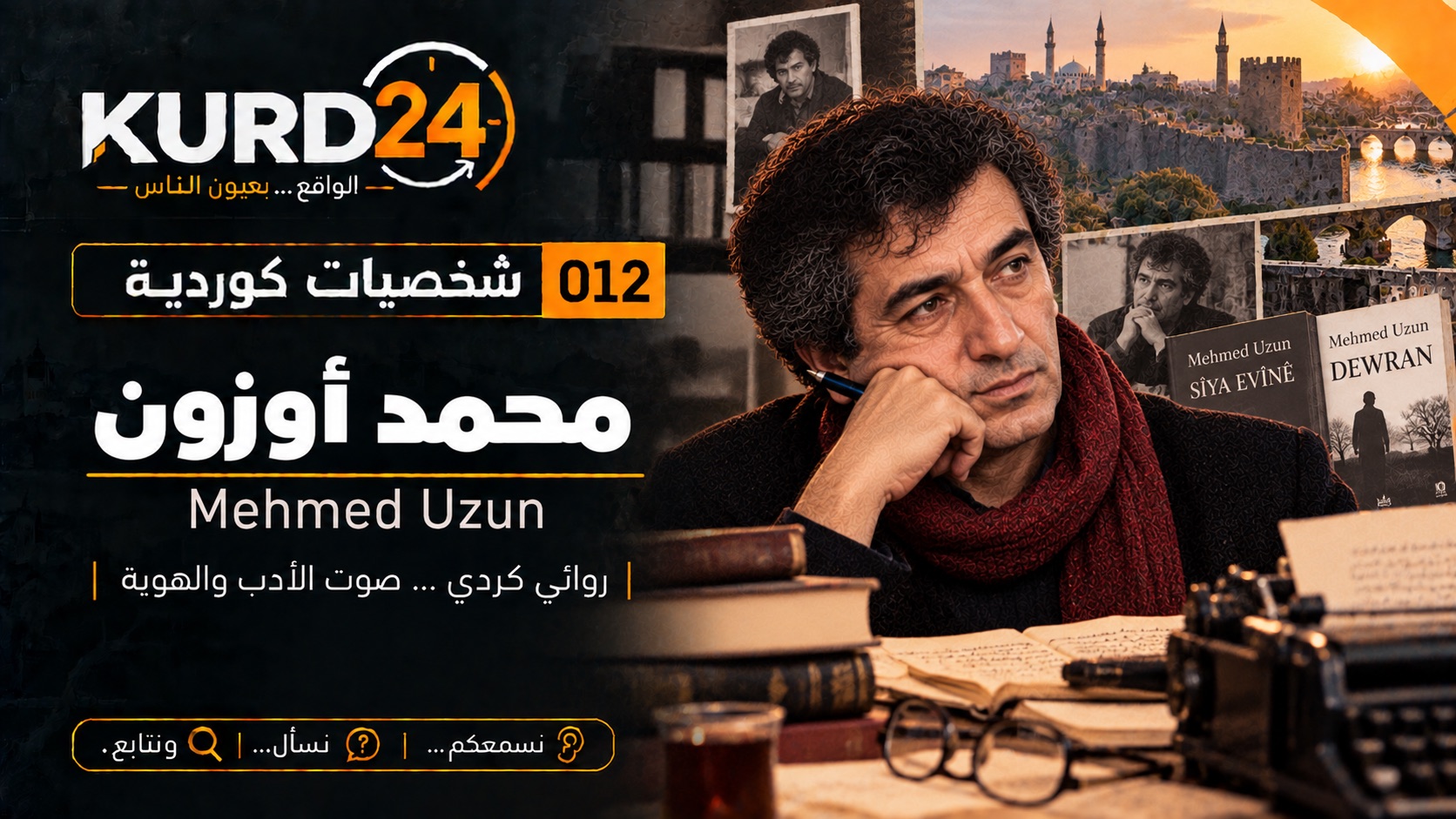
Basic information
- Name:Mehmed Uzun
- Birth: 1953
- Place of birth:Sivric - Sanliurfa, Turkey
- Death:October 2007 - Diyarbakir/Amed
- Domain:Novel, literature, essay and literary research
- The language of his novels:Kurdish - Kurmanji
- What he is most notable for:One of the most prominent contributors to the development of the modern Kurdish novel written in Kurmanji; He wrote seven novels in Kurdish, and lived for nearly three decades in exile in Sweden.
Who is Mehmet Ozun?
The story of Mehmet Ozun is not only the story of a novelist, but the story of a writer who made language itself part of his literary project. He was born in southeastern Türkiye, then went through the experience of detention, and left his country as a young man to settle in Sweden. There, far from the environment in which he grew up, he made a decision that would be fundamental in his career: to write the novel in Kurdish. The challenge was great; The novel needs a language capable of describing the city and the countryside, love and war, memory and history, and the internal dialogue of the characters. Ozon himself spoke about the difficulties he faced in building a modern narrative language, and about the development of his language and style from his first novel onward.
Over the years, he became the author of seven Kurdish novels, in addition to studies, articles, and anthologies, and his works were translated into other languages.
Childhood in Siverik
Mehmet Uzun was born in 1953 in Siverek, Sanliurfa Province, Turkey. He grew up in a Kurdish environment, at a stage when the space for using the Kurdish language in institutions, education, and publishing within Türkiye was very limited. This issue would later become central in his life. The language that he knew from home and the surrounding community was not just a means of communication for him, but it later turned into the language of an entire literary project.
Youth and detention
In his youth, Ozun became involved in Kurdish cultural and political activity, and faced arrest and prosecution in Türkiye. After his release from prison, he found himself facing a new phase that ended with his leaving the country. In 1977, he arrived in Sweden as a political refugee, beginning the longest period of his life outside his homeland. He remained there until his return to Turkey after nearly 28 years of exile.
Sweden...the exile that turned into a literary workshop
Exile could have severed Ozon's connection with his language, but what happened was almost the opposite. In Sweden, he found a broader space for writing, publishing, and research, and became close to the cultural and literary institutions there. He was a member and activist of the Swedish Writers' Union and the Swedish and International PEN, and worked for years within the Swedish literary environment. But the basic problem remained before him: How do you write a modern novel in a language that lacks a broad institutional publishing and teaching structure? Ozon began searching for words, methods, and resources that could help him.
Therefore, his experience was not just writing stories; Rather, it included work on language, heritage, oral literature, and historical sources.
Return to Dingbeig
One of the most important sources that Ozun benefited from was the Kurdish oral heritage. In Kurdish society, Dengbêj played the role of narrator, singer, and preserver of stories, epics, events, lineages, and popular memory. Ozun was interested in this heritage, and also wrote about it, and one of his books was the book Dengbêjlerim, published in 1998. For him, the oral heritage was not a thing of the past that should be copied as it is; Rather, it is material that could be included in the modern novel. Thus, he tried to combine: the ancient Kurdish tale + modern novel techniques.
The first novel: Tu
In 1985, Muhammad Uzun published his first novel: Tu - “You.” This novel represents the beginning of his novel project in Kurdish. Ansiklopediya Kurdistan Writing was difficult at first, and he himself later admitted that there were linguistic and stylistic problems in his early works before his experience gradually developed. But the importance of Tu does not come only from its literary form, but rather from it being an early step in the project of building a modern Kurdish novel in Kurmanji.
Mirina Kalekî Rind
Then came his novel in 1987:
Mirina Kalekî Rind
“Death of a Good Old Man/Death of an Old Rand” is one of the important works in his career. A recent academic study of the novel reveals that it contains subjective elements related to the writer’s experience and exile, and addresses topics such as: alienation, nostalgia, loneliness, memory, loss of place, and the formation of the Kurdish intellectual. Here we begin to see the themes that will accompany Ozon in many of his works: homeland - exile - memory - language - identity.
Siya Evînê
In 1989 it appeared:
Siya Evînê
“The Shadow of Love” is another novel that expanded Ozon’s literary world, and included history, memory, and human relations within the narrative structure. The book appears in literary catalogs of his works, and translations and editions in various languages were later issued. OpenLibrary
Evdalê Zeynikê
In 1991, he published: Rojek ji Rojên Evdalê Zeynikê, “A Day in the Days of Evdal Zeynikê,” and here his relationship with the oral heritage clearly appears. Evdalê Zeynikê is one of the most prominent names associated with the Kurdish Dengbeg tradition, and Ozon’s choice of him reflects his desire to introduce oral memory into the world of the written novel.
He was not only a novelist
In parallel with the novels, Uzun began another project: studying Kurdish literature, collecting it and presenting it to the modern reader. Among his most prominent works are: Destpêka Edebiyata Kurdî - An Introduction to Kurdish Literature Hêz û Bedewiya Pênûsê - The Power and Beauty of the Pen Antolojiya Edebiyata Kurdî - An Anthology of Kurdish Literature in Two Volumes Ziman û Roman - Language and the Novel Dengbêjlerim - Dengbêji, in addition to other books and articles. These works reveal that his project was broader than writing individual novels. He was interested in the question: How can a modern Kurdish literature be built while maintaining the connection to ancient literary memory?
Bîra Qederê
In 1995, he published a novel:
Bîra Qederê
“The Well of Destiny” is one of his novels that goes back to Kurdish history, personalities, and political and social memory. This characteristic has become clear in his literature: Ozon does not write history as a historian, but rather uses historical material within the novel, where reality is mixed with memory, character building, and literary narration.
His most famous novel
Among the most widely published works of Mehmet Ozun is: Ronî Mîna Evînê, Tarî Mîna Mirinê, “Light as Love, Dark as Death,” published in 1998. The catalogs document the Kurdish edition issued by Avesta in that year. Google Books The novel dealt with violence, conflict, love, belonging, and the transformations that political confrontation leaves on a person. An academic study of the novel indicates the presence of themes of political, psychological, and spatial alienation, in addition to the characters’ relationship with the land, language, and culture. But the novel will also bring Ozun into a legal confrontation in Turkey.
Trial because of his books
In 2001, Mehmet Ozun was put on trial in Türkiye over the novel Ronî Mîna Evînê, Tarî Mîna Mirinê and his book of essays Nar Çiçekleri. The case ended with his acquittal. His works, some of which dealt with events and figures from Kurdish history, also faced censorship and judicial problems in Türkiye, according to the Kurdish Institute in Paris. When dealing with this stage, it is best to separate two things: the writer’s political positions on the one hand, and the literary value of his works on the other hand. His main project, which remained after his death, is a literary and linguistic project.
Hawara Dîcleyê – The Cry of the Tigris
In the last stage of his career, another novel project related to the Tigris and Mesopotamia appeared: Hawara Dîcleyê “The Cry/Call of the Tigris.” The first part was published at the beginning of the new millennium, and was followed by another part. The catalogs of the Kurdish Institute in Paris document the presence of the work in its writings during this period. In these works, his interest in history, memory, and the multiple communities that lived in the region expanded.
A writer between three languages
Muhammad Uzun lived among more than one linguist. He said about himself that he writes in three languages, explaining that: his novels are written in Kurdish, his articles are in Kurdish and Turkish, and some of his short texts are in Kurdish, Turkish and Swedish. This is a very important point to understand his personality. He was not isolated within one culture, but rather lived in a space that combined: Kurdish - Turkish - Swedish - European culture. However, he specifically chose Kurdish as the language for his novels.
His relationship with the Kurdish Institute in Paris
When the Kurdish Institute was founded in Paris in 1983, Ozun was one of the first Kurdish intellectuals and artists to be associated with it. He stayed for about a year in Paris, then returned to Sweden for family reasons, but he continued to participate in the institute’s activities, including linguistic seminars related to the development and traditionalization of the Kurdish language. This stage is important because it shows that his linguistic project was not entirely an individual effort; Rather, he was part of a broader environment of writers, linguists, and intellectuals who worked on Kurdish literature in Europe.
His relationship with Yashar Kemal
He had a close relationship with the great novelist Yashar Kemal. The Kurdish Institute in Paris states that Yashar Kemal was close to him to the point that he considered him like an adopted son, both morally and humanely. The two met in their interest in the memory of the region, the people, the village, nature, and social injustice, despite the difference in their language and literary path.
Awards and recognition
During the last years of his life, Mehmet Uzun received a number of awards and honors. Among them is the Freedom of Thought and Expression Award from the Publishers Union in Turkey in 2001. He also received literary honors in Europe and Sweden, including an award related to his cultural contribution from the Swedish Academy in 2002. By that period, his works had begun to be translated into several languages, which brought his experience out of the Kurdish field alone to a wider audience.
Back after 28 years
After about 28 years of exile, Mehmet Uzun returned to Türkiye in the mid-2000s. Sources differ slightly in determining the timing of his final settlement between 2005 and 2006, but the Kurdish Institute in Paris mentions his return in 2005, while his biography with his publisher indicates his continued European residence until his final return in July 2006. The return was very significant for a writer whose most important literary themes were exile, nostalgia, and place. But it came at about the same time as the most difficult health phase of his life.
Disease
Mehmet Ozun was diagnosed with stomach cancer. He returned to Diyarbakir/Amid, where he received treatment in the last stage of his life. As news of his illness spread, he received wide attention from the literary and cultural community, which recognized his works inside and outside Turkey.
His death
Mehmet Uzun died in Diyarbakir in October 2007 after a struggle with stomach cancer. He was approximately fifty-four. The sources I reviewed agree on the month, year, and place, while there is a difference of one day in the date: some mention October 10, others October 11; Therefore, in the brief material, it is better to limit ourselves to “October 2007,” unless we rely on a specific archive to confirm the day.
What did Muhammad Ozun add to the Kurdish novel?
This is the most important point in his story. Mehmet Uzun was not the first person to write literature in Kurdish. Written Kurdish literature is centuries older than him, as we saw with Ahmed Khani, Mulla Mustafa Pisarani, and others. But the stage in which Ozon worked was different. He wanted to develop the modern novel in Kurmanji. To achieve this, he returned to: oral songs and tales, Dengbeg, Kurdish history, ancient vocabulary, popular memory, and written literary sources, and then tried to introduce all of this into the structure of the modern novel. That is why literary sources describe him as one of the main contributors to the formation of modern Kurdish literature, while academic studies confirm his important place in the history of the Kurdish novel.
The major themes in his novels
When looking at Mehmet Ozun’s works together, a clear set of themes recur: exile and estrangement—an experience he himself lived for decades. Language — not just as a writing tool, but as a part of memory and belonging. Love is strongly present even within novels set in violent political circumstances. History and memory — many of his characters look to the past to understand their present. Death and loss—they constantly appear in his fictional world. Homeland and Place – The Tigris, villages, cities and mountains are not just backdrops. Alienation — political, psychological and geographical, is a theme that academic studies of his works have clearly addressed.
His most important works
Among his most prominent novels and literary works are: Tu - 1985 Mirina Kalekî Rind - 1987 Siya Evînê - 1989 Rojek ji Rojên Evdalê Zeynikê - 1991 Destpêka Edebiyata Kurdî - A Study in Kurdish Literature Hêz û Bedewiya Pênûsê – Essays Bîra Qederê – 1995 Antolojiya Edebiyata Kurdî – Two-volume anthology Ronî Mîna Evînê, Tarî Mîna Mirinê – 1998 Dengbêjlerim – 1998 Hawara Dîcleyê – The beginning of the new millennium. A specialized academic study indicates that he ended his life with seven novels in the Kurdish language to his credit.
Why do we remember Mehmet Ozun?
Because his achievement was not one famous book. The broader value of his experience is that he spent decades trying to make Kurmanji a language capable of carrying a long and complex modern narrative, at a time when the institutional structure of Kurdish publishing and education was limited. He left his homeland as a young man, and lived most of his literary life in Sweden, but used exile to research heritage, language, and memory, linking the traditions of the dingpg and the oral tale to the forms of the modern European novel. He wrote about a person who loses his homeland, about a language that searches for a place, about love, war, death, and memory.
That is why when we talk about Mehmet Ozun, we are not just talking about a Kurdish writer who lived in exile; Rather, it is about one of the names that contributed significantly to the consolidation of the modern Kurdish novel in Kurmanji.