Hejar (Abdurrahman Sharafkandi)
Poetry, translation and dictionaries
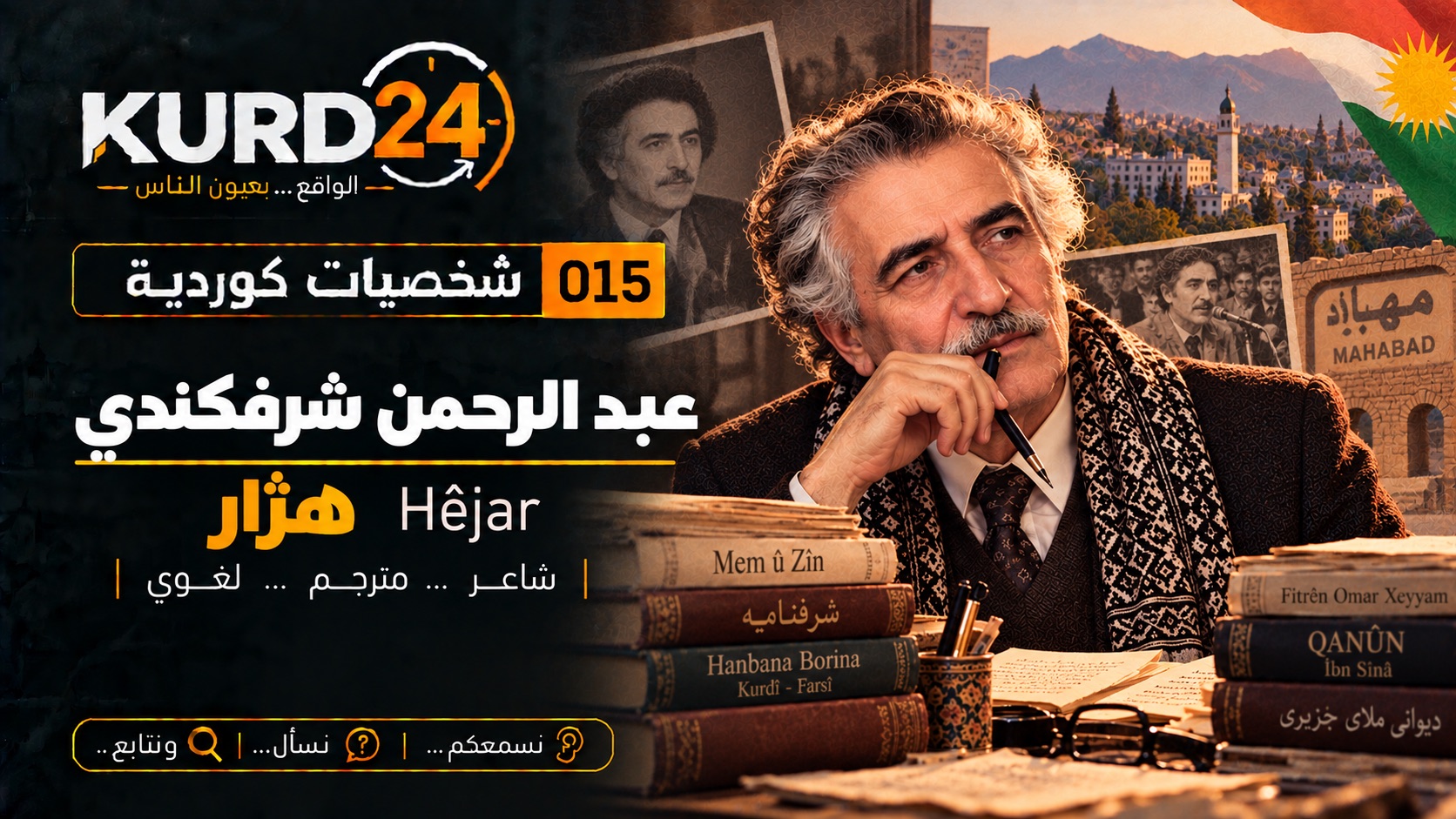
Basic information
- Full name:Abd al-Rahman Sharafkandi - ʿAbd al-Raḥmān Sharafkandi
- Literary name:Hažār – Hêjar / Hejar / Hažār
- Birth: 1921
- Place of birth:Mahabad - Iranian Kurdistan
- Death:February 21, 1991
- Place of death:Tehran - Iran
- Burial place:Budaq Cemetery - Mahabad
- Domain:Poetry, literature, translation, language and dictionaries
- Basic writing language:Sorani Kurdish, and he has works and translations in Persian
- Among his most prominent works:Hanbana Borina, the translation of Mem û Zîn into Sorani, the translation of Sharafnama, the translation of the Rubaiyat of Omar Khayyam, and his complete Persian translation of Ibn Sina’s book The Canon of Medicine.
Who is Hagar?
It is difficult to put Abdul Rahman Sharafkandi in one box. He is a poet, but he was not satisfied with poetry. He is a translator, but he was not satisfied with translating books. He is a linguist and lexicographer who spent many years collecting Kurdish words and expressions. He also lived through a very turbulent period in the region's history, from the events of Mahabad in the 1940s to his years of exile in Iraq and then his return to Iran. Encyclopaedia Iranica describes him as a Kurdish poet, philologist, and translator, while the Kurdish Institute in Paris also presents him as a writer, poet, lexicographer, and translator, and one of the founders of the Kurdish Institute in Paris.
Therefore, Hajar’s story is, in essence, the story of a man who made language his life’s project.
From Mahabad, the story began
Abdul Rahman Sharafkandi was born in Mahabad in 1921. His family belongs to a scientific and religious environment. His father, Mullah Muhammad Sharafkandi, was a man of science, and Iranica credits him with founding the first school for Islamic studies in Sharafkandi, where teaching was in the Kurdish language. This information is very important to understand Hagar. For him, the Kurdish language was not something he discovered at a late stage, but rather it was present within his educational and family environment from the beginning. He began his education in a Qur’anic school in Mahabad, then continued his studies in the Sheikh Burhan Khanqah in Sharafkand near Bukan.
There he met figures who would later become important in his life and in the Kurdish cultural movement. Among the most prominent of them is: Hêmin Mukriyani, the well-known Kurdish poet who was also born in 1921. The friendship between Hêmin and Hêmin has become one of the important cultural relationships in contemporary Kurdish literature.
Why did he call himself “Hajar”?
Abdul Rahman Sharafkandi chose the literary name: Hêjar, and the Kurdish word carries a meaning close to: the poor - the destitute - the deprived. Iranica explicitly refers to him as Hažār, “the poor man”. The name is no longer just a poetic nickname. Over the years, “Hajjar” became more famous than his real name itself, to the point that many people know the poet as Mamistha Hijjar - Professor Hijjar. The name also resonates with an obvious aspect of his literature: interest in people's suffering, language, identity and social life.
His poetic beginnings
Hjar began writing Kurdish poetry in his youth, and sources place the beginnings of his poetic activity approximately in the early forties. But his life was not only literary. The area surrounding Mahabad was going through major political transformations during World War II and its aftermath. In 1942, Hajjar joined the Komalay Jiyanaway Kurd Kurdistan Revival Association, a movement that Iranica describes as a predecessor to the Iranian Kurdistan Democratic Party, which was later associated with the establishment of the Mahabad Republic.
Hazar and the Republic of Mahabad
In January 1946, the short-lived Kurdish Republic was declared in Mahabad, headed by Qazi Muhammad, the character we discussed in Episode 009 of the series. During this phase, Hajjar became one of the most prominent literary voices associated with the project. Iranica mentions that Hejar became the poet of the republic, and it also mentions in its material on Kurdish written literature that Hejar and Hemin were known during the Mahabad Republic as “poets of the nation.” Here poetry became for him directly linked to the events he was experiencing. Literature is no longer a world separate from society.
Rather, it has become a means of expressing: language, land, society, identity, and political events.
The fall of the Republic... and the beginning of exile
The Republic of Mahabad did not last long. With the Iranian government regaining control of the region in late 1946, the republic ended, and Qazi Muhammad and a number of its leaders were executed in March 1947. As for Hajjar, he entered a new phase of his life: exile. He left Iran and settled in Iraq, beginning a long journey that extended for years between different countries. His biography, according to the Kurdish Institute in Paris, presents scenes from Iran, Iraq and Syria and covers an important aspect of the region’s history between 1941 and 1975. This experience made the concept of alienation present in his life and writings.
Iraq... the second major stop
Iraq later became one of the most important places in Hijjar's life. In the 1960s, he was associated with the Kurdish movement led by Mustafa Barzani, which we discussed in Episode 004. Iranica states that during the armed conflict between 1961 and 1975, he assumed responsibilities related to the Kurdish movement’s radio station, “Voice of Iraqi Kurdistan,” and to the Xebat newspaper, affiliated with the Kurdistan Democratic Party in Iraq. This is a political stage in his biography, but its cultural importance is also great. Radio and journalism gave him a new space to work in the Kurdish language outside of poetry and books.
The March 11 Agreement and the Baghdad Phase
After the March 11, 1970 agreement between the Iraqi government and the Kurdish leadership, the region entered a truce phase that lasted several years. During that period, Hajjar lived in Baghdad. There he assumed the presidency of the Kurdish Writers Union, and was an active member of the Kurdish Scientific Academy. This stage is very important in his scientific development. Because Hajar became more involved in projects: language - dictionaries - translation - heritage investigation.
Hagar and Ahmed Khani
One of his most important cultural achievements was his relationship with one of the most important books in Kurdish literature: Mem û Zîn – Mem and Zîn by Ahmed Khani, character No. 001 in our series. Ahmad Khani wrote his work in Kurmanji in the seventeenth century. As for Hajjar, who wrote mainly in Sorani, he worked on translating Mem û Zîn from Kurmanji to Sorani. Iranica records the first edition of this translation in Baghdad in 1958. This work carries important cultural significance: a twentieth-century Kurdish poet reintroduces a seventeenth-century Kurdish poet to readers of another Kurdish dialect.
Thus, translation according to Hajjar was not merely a transfer between words. It was also a means of linking parts of the Kurdish literary heritage to each other.
Translated by Sharafnama
Another of his major projects is the translation of: Şerefname - the famous historical book written by Sharaf Khan Al-Ballisi, character No. 006 in our series. The original was written in Persian in the late sixteenth century. Hajar translated the book into Sorani Kurdish. Iranica records the publication of his translation in Baghdad in 1973. Here we notice something beautiful in the sequence of “Kurdish Personalities”: 001 Ahmad Khani → Hajar translates Mem û Zîn 006 Sharaf Khan al-Badlisi → Hajar translates Sharafnameh 015 Hajar → brings these works back to a contemporary Kurdish reader.
This explains why translation was an essential part of his cultural project.
The Rubaiyat of Omar Khayyam
His interest was not limited to Kurdish literature. Also translate:
The Rubaiyat of Omar Khayyam
From Persian to Kurdish. Iranica records the publication of his translation in Beirut in 1968. Thus, he worked in two directions: transmitting the Kurdish heritage between its dialects, and transmitting works from the surrounding cultures to the Kurdish reader.
The Mega Project: Law in Medicine
But the biggest surprise in Hagar’s career comes from a book that does not belong to Kurdish poetry. It is: The Law of Medicine - Ibn Sina, the famous encyclopedic book of Ibn Sina. Hijjar translated the law in medicine from Arabic to Persian. It was not a brief translation. It was a complete translation in five volumes, published in Tehran between 1979 and 1986. Encyclopaedia Iranica describes it as: the first complete Persian translation of this great work. This achievement alone reveals the extent of his linguistic abilities. The man who became famous as a Kurdish poet dealt with an extremely difficult Arabic medical and philosophical text, and was able to completely translate it into Persian.
Return to Iran
In 1975, the Kurdish armed movement in Iraq collapsed after the Algiers Agreement between Iraq and Iran and the cessation of Iranian support for it. After that, Hajjar returned to Iran. He settled in Karaj, near Tehran. From this stage began one of the most scientifically productive periods of his life. He relatively stayed away from daily political life, and devoted a large part of his time to: the Kurdish language, dictionaries, translation and investigation.
Hanbana Borina
If we want to choose one book that represents Hajjar as a linguist, it is: Hanbana Borina, which is a huge Kurdish-Persian dictionary that has become one of his most famous linguistic works. Iranica records its publication in Tehran in 1990, and library catalogs confirm that it is a dictionary of the Kurdish and Persian languages extending to hundreds of pages. But the importance of the dictionary is not only in the number of words. Hajjar was interested in the nuances between vocabulary and expressions, and did not limit himself to one dialect. Iranica explains that he was writing in the Makri dialect of Kurdish, but used words and expressions from multiple Kurdish dialects, in an attempt to bring the Kurds closer culturally through language.
This is a central point in his project. For Hajjar, the dictionary was not just a list of words. It was an attempt to preserve the wealth of the language.
Hjar and Kurdish dialects
This case was very important to him. Kurdish is not one dialect that is identical in all regions. There are Sorani, Kurmanji, and other dialects and branches, in addition to many local differences. Hajar tried to benefit from this diversity instead of seeing it as a problem. When he translated Mem û Zîn, he transferred a work from Kurmanji to Sorani. When he prepared his dictionary, he collected vocabulary and expressions from more than one region. Iranica says that this multiple use of dialects was related to his desire to bring the Kurds closer culturally.
Investigation by Diwan Malay Jaziri
Hajar also worked on the legacy of: Melayê Cizîrî, one of the great poets of classical Kurdish literature. He edited/explained his collection, and Iranica registered the publication of the work in Tehran in 1982. Thus we see a clear line in his project: Ahmad Khani → Malay Jaziri → Sharaf Khan al-Ballisi → Modern Kurdish language. That is, Hagar was trying to build a bridge between the ancient Kurdish heritage and the contemporary reader.
Translation of the Qur’an into Kurdish
Another important work associated with his name is the translation of the Qur’an into Sorani Kurdish. The catalog of the Kurdish Library of the Kurdish Institute in Paris documents a published copy of: Quranî Pîroz translated by Mamosta Hajjar, and describes it as a Kurdish translation of the Qur’an, with the Kurdish text versus the Arabic text. Institute Kurde
This project connects directly to his early background in Islamic studies and the Arabic language. A child who began his education in a Qur’anic school returned decades later to the same text, but this time translated into his Kurdish language.
was not translated literally
Translation, according to Hajjar, was not merely a matter of replacing one word with another. He had knowledge of Arabic, Persian, and Kurdish, and at the same time worked on heritage, literature, and dictionaries. This is why he combined: knowledge of the original text + knowledge of the language to which it was transferred + knowledge of culture and history. This explains the diversity of works that he was able to deal with: from a poetic epic such as Mem û Zîn, to a history book such as Sharafnama, to poetic philosophical quatrains by Omar Khayyam, to an encyclopedic medical book by Ibn Sina, to a religious text such as the Qur’an. This diversity is extraordinary in the career of one writer.
Hajar the Poet
All of these works may make us forget the starting point: Hajjar was the first poet. His poems were related to his personal experience, society, and the events he lived through. His poetry was influenced by poverty, exile, language, identity, and political transformations in the region. His experience in Mahabad made him one of the most prominent poets of that period, along with Heman Mokryani. But the value of his poetry is not limited to its association with a specific political event; His name remains present because his literary activity spanned decades, while his works later expanded into language, translation, and documentation.
His biography: Micêwir
Hjar also left behind one of the most important sources for understanding his life: Micêwir Micêwir, which is his autobiography. Iranica records that the book was published posthumously, edited by Khani Sharafkandi, in Paris in 1997. In 2023, the Kurdish Institute of Paris presented the French translation of this biography under the title Du Coq à l’âne. The book is important not only because it tells the story of its author. According to the Kurdish Institute, his memoirs provide a broad picture of the events and transformations that Kurdistan and the region witnessed between 1941 and 1975, and move between Iran, Iraq, and Syria.
Therefore, the book can be read on two levels: a biography of a person, and a testimony to an era.
Hajar and memory
One of the striking things about his project is that most of his work revolves, in one way or another, around preventing something from being lost. When he creates a dictionary: he memorizes the words. When he translates Mem û Zîn: he preserves the literature and makes it available to another audience. When he translates Sharafnameh: He brings history back to the Kurdish reader. When Diwan Malay Jaziri achieves: he memorizes classical poetry. When he writes his memoirs, he preserves the personal experience and history he lived. This is why Hajjar can be viewed as more than a poet: his major project was cultural memory.
His final years
After returning to Iran in 1975 and settling in Karaj, Hajjar continued to work intensively on his linguistic and translation projects. During this stage, his huge translation of Al-Qanun fi al-Tibb, his translation of Diwan Malay Jaziri, and his dictionary Hanbana Borina appeared. That is, his late years were not a stage of retirement. Rather, it was one of the most productive phases of his life.
His death
Abd al-Rahman Sharafkandi-Hajjar died in Tehran on February 21, 1991, according to the date provided by Encyclopaedia Iranica. There are some secondary sources that give the year 1990 or a slightly different date, but the Iranica reference clearly gives February 21, 1991, so we use it here. After his death, he was returned to Mahabad. He was buried in the Bodāq cemetery in the city where his story began. Thus, after decades of movement and exile between Iran, Iraq and elsewhere, his journey ended in his homeland.
Why do we remember Hagar?
Because Hagar did not leave just one kind of legacy. If he had only written poetry, he would have been an important poet. If only he had completed his dictionary, he would have been a linguist worthy of study. If only Mem û Zîn and Sharafnamah had been translated, it would have had an important place in the history of Kurdish translation. If his complete translation of Al-Qanun fi al-Tibb had been his only work, it would have been a major scientific achievement in itself. But he did almost all of that in one life. He started out as a student in a religious school in Mahabad. He became a poet. He lived the experience of the Republic of Mahabad. He entered exile. He worked in journalism and radio in Iraq.
Participated in literary and scientific institutions. He translated between Kurmanji and Sorani, between Persian and Kurdish, and between Arabic, Persian and Kurdish. Collect words into a dictionary. Achieve heritage. He wrote his memoirs. Therefore, the best way to understand Hajjar is not just as a poet, but as: a poet who carried language with him wherever he went.