
Cegerxwîn
Poetry, literature and language
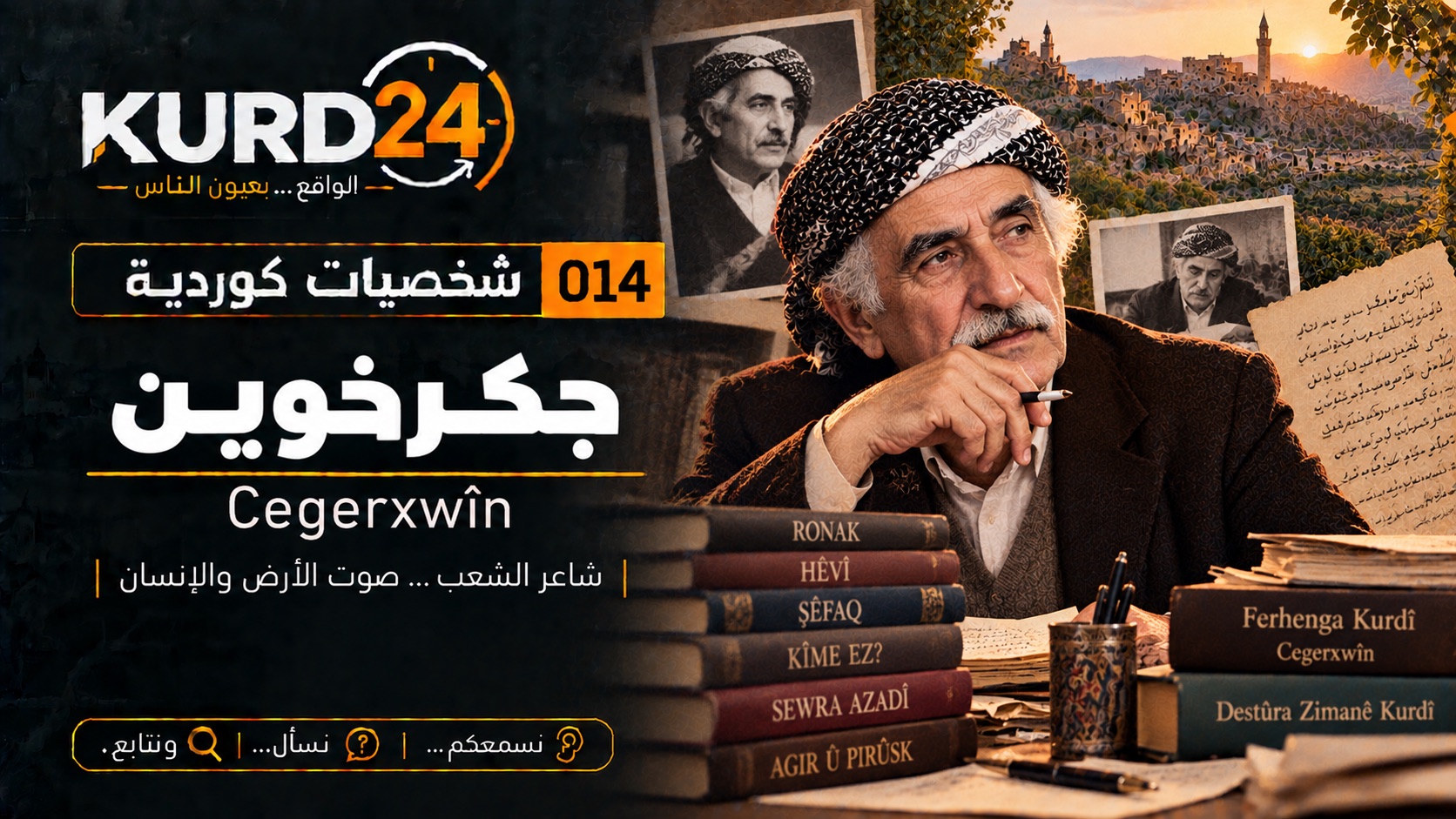
Basic information
- Real name:Sheikhmus Hassan - Şêxmûs Hesen
- Literary name:Cigerxwîn – Cegerxwîn / Cigerxwîn
- Birth: 1903
- Place of birth:Hesar village, in the historic Mardin region, within the borders of present-day Turkey
- Death:October 22, 1984
- Place of death:Stockholm - Sweden
- Domain:Poetry, literature, language, dictionaries and history
- Basic writing language:Kurdish - Kurmanji
- What he is most notable for:is one of the most prominent Kurmanji poets in the twentieth century. In his experience, he combined classical poetry with direct popular language, and wrote about poverty, work, love, education, social justice, and the Kurdish language and identity.
Who is Jakarkhwain?
If Ahmad Khani represents one of the major stations in classical Kurdish poetry, then Jakarkhwain represents a completely different stage: the transition of poetry to the heart of the social and political transformations that the Kurds experienced in the twentieth century. He did not begin his life in a wealthy home or a large literary school. He started it as a poor child, then an orphan, a shepherd and an agricultural worker. He later studied in religious schools and became a mullah, but he gradually turned into a poet, writer, and linguist, and spent a large part of his life moving between Syria, Iraq, Lebanon, and then Sweden.
Encyclopaedia Iranica describes him as considered by many to be the most prominent Kurdish poet who wrote in Kurmanji in the twentieth century.
A child from the village of Hisar
Sheikhmus Hassan was born in 1903 into a poor family in the village of Hesar - Hisar in the region located in present-day southeastern Türkiye. He lost his parents when he was young. Due to poverty and constant movement, he was unable to attend a regular school, but he received lessons in reading the Qur’an from the mullahs of the villages where his family resided. After the death of his parents, he lived for a while with his sister's family, and had to work early.
The shepherd and the agricultural worker
Jakarkhwain worked as a shepherd and agricultural worker. These details may seem like just a stage of his childhood, but they are very important for understanding his poetry later. He knew the life of peasants, workers, and the poor from within, not from books. At the same time, he listened to and memorized poems and songs performed by the dervishes, an experience that Iranica says later became one of the sources of inspiration for his social poetry.
From poverty to religious school
Beginning around 1920 he began a long period of study in traditional religious schools. He moved in search of knowledge between regions in Syria, Iraq, and Iran. He studied religious sciences, language and literature, and became acquainted with the classical Kurdish poetic heritage. Among the poets whose heritage was influenced by him were: Malay Jaziri - Melayê Cizîrî Fiqh Tairan - Feqiyê Teyran Ahmed Khani - Ehmedê Xanî Ali Hariri - Elî Herîrî in addition to Nali and other poets of the region. This study left a lasting impact on his poetry. Even when he later became a social poet with a direct language, he remained able to use meters, styles, and images inherited from classical Kurdish poetry.
became “Mullah Sheikhmous”
He married in 1927, and from 1928 until 1936 he worked as a mullah in a number of villages. He was thus on a path that could have made him a cleric and teacher throughout his life. But he began to see the society around him in a different way. He saw the poor farmer. He sees the authority of the landlords, the senate, and the sheikhs. He sees the differences between classes. These scenes gradually turned into social questions that would later become among the most important topics of his poetry.
When did he start writing poetry?
According to his biography, he began writing poetry approximately in 1924. During the period of his work, he wrote his first collection of poetry, but it was lost and has not reached us. As for his first published collection, it appeared later in Damascus in 1945. But before that, a very important transformation occurred in his personality. Sheikhmus Hassan turned into: Cegerxwîn. He chose for himself the literary name: Cegerxwîn - Jakarkhoen. The name carries a meaning close to: “the one with the bloody liver” or “the sore/wounded heart,” according to the way the Kurdish expression was translated into Arabic. Iranica links his choice of this name to his social and political experiences, and to the impact that events in the region had on him, including the suppression of the Sheikh Saeed Uprising in 1925.
Since that time, the name has ceased to be merely a literary signature. It became the identity by which he was known throughout his life.
Poetry turns into a social voice
In the 1930s his literary and social activity became more evident. One of the basic questions in his poetry was: Why does a peasant who works the land live poor? He criticized social relations that he saw as allowing the exploitation of peasants and the poor, and attacked the authority of the agas, some sheikhs, and feudal lords. Iranica shows that his concept of liberation was not only nationalistic; He also linked it to social justice and the liberation of the peasant from exploitation within Kurdish society itself. This is an essential point to understand. His poetry did not simply say:
“There is a problem between the Kurds and the authorities surrounding them.” Rather, he was also saying: There are problems within Kurdish society itself that must be changed.
Hawar Magazine
The 1930s were a very important stage in the development of Kurdish writing in Kurmanji. In Damascus, Celadet Bedirxan founded the magazine: Hawar in 1932. The magazine became one of the most important platforms in the history of modern Kurdish literature in Kurmanji. Jakarkhoen's poems were published in Hawar, as well as in the Ronahî magazine associated with the same cultural circle. The Kurdish Institute in Paris states that his poetry began to appear in these two magazines in the 1930s. This had a huge impact. A poem that was once heard locally was now a printed text that could be transmitted among readers.
The first collection of poems: Agir û Pirûsk
In 1945, his first published collection of poetry was published in Damascus: Agir û Pirûsk “Fire and Sparks/Lightning,” according to the different translation of the title. It is the first in a long series of his poetry collections. Then came: Sewra Azadî - 1954 “Freedom Revolution” and here the features of his poetic project became clearer. Poetry, according to Jakarkhoen, is not only a linguistic decoration. It is a way to talk about: freedom - poverty - education - injustice - society - land - language - identity.
A poet in the language of the people
One of the most important reasons for the spread of Jakarkhwain’s poetry is its style. He did not want to write only for the elite. Iranica says that his poetic language was often natural, simple, direct and close to everyday language, while at the same time retaining clear literary qualities. This is very important. Because the poet who wants to address the peasant, the worker, and the young man cannot always rely on very complex language. Therefore, Jakarkhoen mixed: classical heritage + popular language + modern vocabulary. He was also able to combine old and new words in a way that gave his poetry a special linguistic character.
Love is also present
It is wrong to reduce Jakarkhoen to political poetry. He also wrote love poems, and poems about daily life, nature and people. Iranica confirms that he has a large number of beautiful love poems and touching poems about the details of life, even if his social and patriotic poems have become the ones most associated with his name. This diversity is what makes him a poet and not just a poet of slogans.
From religion to leftist thought
Jekerkhoen's ideas underwent major transformations. He began his life as a student of religious sciences, then became a mullah. But over time, he adopted more radical social ideas, and in 1949 he joined the Syrian Communist Party, influenced by socialist ideas and anti-colonial discourse at that stage. But his relationship with the party did not continue. In 1957, he broke away from the communists due to differences in priorities and principles, then joined the Kurdish Democratic Party in Syria. It is important here to deal with his political experience as part of the development of his thought and historical biography, and not to reduce his literary legacy to a single party affiliation.
Arrests
His political and social activities led to his arrest more than once. Iranica states that his first arrest was in 1949. This was a familiar experience in the lives of a number of Kurdish writers in the twentieth century, as cultural and linguistic activity intertwined with state, political, and identity conflicts. But Jakarkhoen continued to write.
The trip to Baghdad
After the fall of the Iraqi monarchy in 1958, Jakarkhwain moved from Syria to Iraq. And here a completely different phase began. The man who began his life as a shepherd and almost illiterate, then studied in religious schools, now works at the University of Baghdad. Between 1959 and 1963, he worked as a lecturer in Kurdish language and literature in Kurmanji at the University of Baghdad. This is one of the most beautiful transformations in his biography: the child who could not enter regular school became a language professor at the university.
He was not only a poet... but a linguist
While in Baghdad, he started an important project to serve the Kurdish language. In 1961, he published: Destûra Zimanê Kurdî, Grammar of the Kurdish Language, and he prepared the book as a basis for his students. The following year, 1962, he published two volumes of: Ferhenga Kurdî Cegerxwîn The Kurdish Dictionary of Çekerkhoen. Iranica believes that this work reflects his great sensitivity to the richness of the Kurdish language and its expressive nuances. This is an aspect that not many people know about him. Jakarkhoen is not only the author of famous poems. He is also: a language researcher, grammarian, and lexicographer.
Return from Iraq
In 1962, the Iraqi government forced him to return to Syria, according to Iranica. Then he continued to move during the following years between Syria, Iraq, and Lebanon. Thus, his life became linked to the vast Kurdish geography, exile, and constant movement.
“Kîme Ez?” -Who am I?
In 1973, he published his third collection of poetry in Beirut: Kîme Ez? “Who am I?” The title alone sums up a central question in his experience: identity. Who am I? What is my language? What is my history? What is my place? What is the relationship between man, his land, and his society? Then he also published in Beirut the poetic work: Salar û Mîdya – 1973.
Sweden years
In 1979, Jakarkhoen settled in Stockholm - Sweden. He had reached his mid-seventies, but his final years were not a stopping phase. On the contrary, it became a very productive period. Published: Ronak – 1980 Zend-Avista – 1981 Şefaq – 1982 Hêvî – 1983. That is, he published almost a collection of poems every year during his last years.
Eight collections
Iranica records his major poetry collections as follows: 1. Agir û Pirûsk – 1945 2. Sewra Azadî – 1954 3. Kîme Ez? – 1973 4. Ronak – 1980 5. Zend-Avista – 1981 6. Şefaq – 1982 7. Hêvî – 1983 8. Aşitî – 1985, and it was issued after his death. He also published other works, including Şerefnameya Menzûm in 1977.
Children's books and stories as well
His production was not limited to poetry. Among his works are: Cîm û Gulperî - Damascus, 1948 Reşoyê Darê - Damascus, 1956. Thus, his production extends from poetry to stories, education, language, history and folklore.
Kurdistan History Project
Çekerkhoen also worked on: Tarîxa Kurdistan, a three-volume work published posthumously. The book covers the history of the Kurds up to the thirteenth century, noting that Jakarkhoen himself did not present it as a definitive academic study by modern standards, but rather was aware of the nature and limits of his historical project. This distinction is important: his value as a poet and linguist does not mean that all his historical conclusions should be treated as a modern academic consensus.
Folklore collection
Folklore has been a primary source for his poetry since his childhood. During his travels, he collected material from folk poetry, songs, and stories. The book: Folklora Kurdî: Kurmancî – 1988 was published posthumously. Thus he eventually returned to the material he had heard as a child from dervishes, singers and ordinary people.
He wrote his life story himself
Çekerkhoen also left an autobiography entitled: Jînenîgariya Min “My Biography/The Story of My Life,” published after his death in Stockholm in 1995, then translated into Turkish under the title Hayat Hikâyem. This biography is very important because it provides direct material about his childhood, poverty, studies, and his intellectual and political transformations.
Why were his poems turned into songs?
The direct language and strong rhythm make a large number of Jakarkhoen's poems suitable for singing. Therefore, his poems entered Kurdish music and were performed by artists in different generations. This gave his poetry another life. The reader may know him from the collection, but another person may memorize his words because he heard them in a song without reading a book of his. That is why part of his legacy has become present in the common space between: poetry, music, and popular memory.
Classical or modern poet?
The closest answer is: both. This is one of the most exciting things about his experience. He knew the traditions of classical Kurdish poetry well as a result of his religious and literary studies, but at the same time he used a simpler and more direct language and addressed modern social issues. Iranica describes his literary personality as having combined many contradictions and transformations: classical and modern, spiritual experience and intellectual transformation, nationalism and socialism. This diversity prevents it from being reduced to one description.
What was he standing for?
Çekerkhoen's intellectual world can be summarized in a group of issues that continued to appear in his works: the Kurdish language and education in it. The life of peasants and the poor. Social justice. Resisting the exploitation of man by man. Kurdish identity and culture. Freedom. Love, nature and everyday life. His political positions were also influenced by leftist and anti-colonial movements in the twentieth century, including his support for the Soviet Union at certain stages. These are positions that must be understood in the context of their time and its intellectual transformations.
His death
Jekerkhoen died in Stockholm on October 22, 1984. He was about 81 years old. The Kurdish Institute in Paris mourned his death in its bulletin issued in late 1984, and at that time presented examples of his poetry. His body was then returned to Qamishli, where he was buried. Biography sources state that his grave is located near his house in the city. Thus his geographical journey ended after a life that extended between: siege - the Syrian Jazira - Iraq - Iran - Damascus - Baghdad - Beirut - Stockholm - Qamishli.
Why do we remember Jakarkhwain?
Because the story of Çekerkhwain summarizes a broad transformation in Kurdish culture during the twentieth century. He was born poor and had no formal education. He worked as a shepherd and farmer. Then he entered religious school and became a mullah. Then he turned into a social poet. Then he became a writer, linguist, lexicographer, and university lecturer. He wrote about the farmer and the poor, love, homeland, language, freedom, and social justice. He published collections, a dictionary, a grammar book, collected folklore, and wrote history and his autobiography. Most importantly, he tried to make poetry understandable and approachable to people.
This is why Jakarkhwain did not remain a poet preserved only in books; Rather, his words entered the song, popular memory, and modern Kurdish culture. His literary importance lies precisely in his ability to stand between two worlds: the heritage of classical Kurdish poetry that he learned in religious schools, and modern social literature that wanted to address the common man in his daily language.