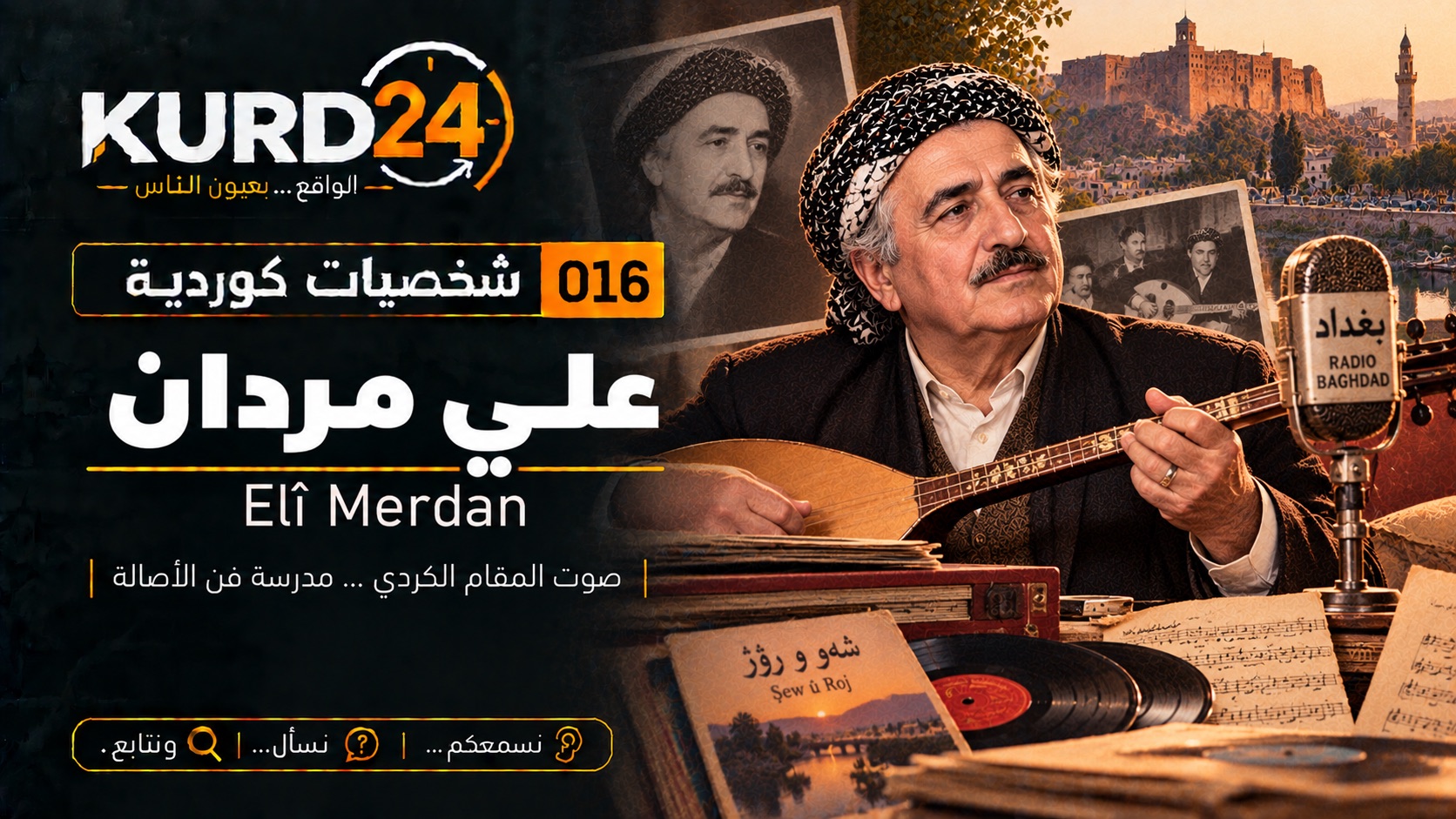
Ali Mardan
Kurdish singing and maqam
Basic information
- Name:Ali Merdan Qadir - Elî Merdan Qadir
- Birth: 1904
- Death:July 24, 1981
- Age:About 77 years
- Associated area:Kirkuk - Iraqi Kurdistan
- Domain:Singing, maqam, composition and music education
- Basic singing language:Kurdish - Sorani
- What he is most notable for:One of the most prominent professors of Kurdish maqam and singing in the twentieth century, and he was one of the founding voices of the Kurdish presence on Baghdad Radio. Kurdish musical sources describe him as one of the founders of the modern Kurdish maqam school.
Sources differ in determining the exact day and month of Ali Mardan’s death in 1981. Some biographies mention July 24, while the Kurdipedia archive mentions January 24.
Who is Ali Mardan?
When we talk about the history of recorded Kurdish song in the twentieth century, Ali Mardan’s name appears at a crucial stage: the stage in which the song began to move from councils, hospices, and local parties to the microphone, radio, and recording. But Ali Mardan was not just the owner of a beautiful voice. He was a maqam juan, composer, teacher, and practical researcher in maqams and melodies, and his school influenced a number of the most prominent voices that came after him. Musical sources describe him as one of the most prominent people who contributed to organizing and developing the Kurdish Maqam tradition, while his recordings remain a model of classical performance that gives priority to the word, poetry, and Maqam.
The beginning... 1904
Ali Mardan was born in 1904. But his place of birth requires some caution. The most widespread narrative links him directly to the city of Kirkuk, and some sources state that he was born in the Sheikh Ali hospice neighborhood there. On the other hand, a detailed Kurdish biography states that he was born in the village of Kanî Sard in the Sharbazir region, then he moved with his family when he was young and settled there. Regardless of the difference, the city that created the bulk of his artistic formation was: Kirkuk. A multicultural and multilingual city, Kurdish, Iraqi, Turkmen and Arab musical traditions intertwine.
This diversity will later appear in Ali Mardan’s musical composition.
Hospice...the first music school
Ali Mardan did not begin his artistic career in a modern music institute. He started it in: Hospice. The sources mention that he received his education in the Kirkuk hospice under Mamosta Saleh, and he learned from Mullah Raouf, who had a well-known voice, to recite the Qur’an, in addition to some Kurdish Maqamat and Turkmen Qur’iyat. This is a very important point. Religious chanting, Qur’an recitation, and Maqams were historically important schools for training the voice and musical ear in Iraq and the region. Among them, the young man learned: self-control, lengthening the tone, moving between pitches, careful listening, and adjusting the position.
These skills would later become the core of his style.
He lost his father early
Circular biographies state that Ali Mardan lost his father when he was a child, which placed him with family responsibilities at an early age. Wikipedia His childhood, then, was not a direct path to artistic professionalism. He had to combine the responsibilities of life with his growing interest in sound and music. But his surroundings were giving him something that could not easily be learned from books: listening. He would listen to reciters, singers, and maqamim, and try to understand the way a musical phrase is structured.
From Kirkuk to Laylan
A detailed Kurdish biography states that after years of studying in the hospice, he left Kirkuk for a while to go to Leylan. There he met a tambour player named: Xidir Baram. The biography says that Ali Mardan benefited greatly from him in learning about Kurdish maqams and melodies. This was an additional stage in its formation. After the religious and vocal school, he became closer to folk music, instrumentation, and melody.
He was not satisfied with Kurdish music
One of Ali Mardan's strengths is that he did not limit himself to one musical tradition. Sources mention that he learned and studied aspects of: Kurdish Maqam, Iraqi and Arabic Maqam, Persian music, and Turkmen Qurayyat. His biography also mentions his knowledge of Kurdish, Arabic, Turkish, and Persian. This diverse environment helped him develop a broad ear for music. But the result was not his abandonment of Kurdish music. On the contrary: he used his knowledge of the surrounding Maqams to develop his own way of performing the Kurdish Maqams.
What is the maqam?
To understand the importance of Ali Mardan, we must pause for a moment at the word: maqam. Maqam is not a single song nor just a memorized melody. It is a melodic system that has degrees, paths, transitions and rules in performance. A singer who is proficient in the maqam does not just perform the words; Rather, he knows how to start, how to raise the voice, how to move, how to return, and where he can improvise without losing the identity of the place. Hence the title:
“Mamista – The Professor”
What was linked to Ali Mardan was not only related to his age. Rather, by his status as a knower of the position and a teacher of it.
Baghdad... the great transformation
Then came the stop that would change his career: Baghdad. In the first half of the twentieth century radio became an entirely new means of disseminating music. Before radio, the artist needed the audience to be present in front of him. After radio, one voice in Baghdad was able to reach thousands of listeners in distant cities and villages. In 1939, a very important stage began in the history of Kurdish broadcasting from Baghdad, and the name of Ali Mardan was associated with the early beginnings of the Kurdish section on the radio. Some sources describe him as one of those who launched the Kurdish broadcast there. Wikipedia
The first recorded maqam
The Kurdish biography of Ali Mardan states that the first maqam he recorded for radio in 1939 was: the maqam “Ay Ay - Ay Ay”, which he performed in Kurdish, in the Bajlan dialect, according to the source. This information is important because it places Ali Mardan directly at one of the major turning points: the transition of the Kurdish Maqam from live performance to the radio archive. The sound no longer disappears after the end of the council. It can now be recorded and rebroadcast.
Ali Mardan and Maryam Khan
Here our sequence meets again. In Episode 013, we talked about: Meryem Xan, who has become one of the most important Kurdish women’s voices associated with Baghdad, radio, and recording. Around the same period, Baghdad was collecting Kurdish votes from different regions. Radio became a place where: maqam, dingpig, folk song, poetry and modern music met. Ali Mardan was one of the most important representatives of the Kurdish Maqam school in this environment.
Hassan Zirk enters the scene
Then comes another name that we previously discussed in Episode 010: Hesen Zîrek. When Hassan Zirk arrived in Baghdad in the 1950s, he found a Kurdish radio environment more developed than it had been two decades earlier. Kurdish music sources place Ali Mardan among the artists who influenced the subsequent golden generation of singers, mentioning among them Hassan Zirk, Muhammad Salih Dylan, Mamli, Taher Tawfiq and Ahmed Shamal. Wikipedia But we must be precise here: it is better to talk about influence and art school than to assume that all of these were his direct disciples in the academic sense.
Why was it different?
Ali Mardan did not rely solely on the power of the voice. He was concerned with three elements: status + poetry + performance. In the classical school he represents, sound must serve the text. The goal is not just to show the singer's ability to reach a high level. Rather, conveying the meaning of the poetic line and the emotion contained in it. This is why Kurdish music sources describe his recordings as an example of the idea: “Poetry first.” That is, the melody and sound work to serve the word.
The teacher
Ali Mardan's influence on others is perhaps as important as his personal recordings. He did not keep his knowledge to himself. Kurdish sources mention that he encouraged a number of talented young men and helped them develop their voices and knowledge of maqamat. That is why the name Ali Mardan became associated with the idea: school. Not because he necessarily founded an official institute bearing his name, but because his method of performing and teaching became a reference for those who came after him. That is why some modern sources describe him as: “the father of the Kurdish maqam school.” This is a common evaluative description, not an official title.
Was he a singer or a composer?
Monday. Sources describe Ali Mardan as: singer - maqam khwan - composer - teacher. Kurdish musical testimonies indicate that he not only preserved ancient maqams, but also contributed to formulating melodies, maqams, and performance forms that became part of the later musical heritage. YouTube But today it is difficult to determine the personal authorship of each piece attributed to him. Like many artists of that generation, there is an overlap between: popular heritage, inherited maqam, re-composition, and personal authorship. Therefore, it is better not to attribute everything that led to its authorship.
How many songs did he sing?
There is a circulating story that says that Ali Mardan performed more than a thousand songs and maqams during a career that spanned nearly half a century, but not all of them were recorded or preserved. Wikipedia This information comes mainly from accounts of relatives and acquaintances and not from a complete catalog of records. Therefore, the most accurate formulation is: Ali Mardan is credited with hundreds of recordings and performances, and accounts close to him state that his credit exceeded a thousand songs and maqams, but a large part of his early production has not been preserved on record.
This is normal for an artist who started his career before the recording became widespread.
“Shaw and ڕۆژ” – Night and Day
Among the works that remain associated with his name is the song: Şew û Roj - Shaw and ڕۆژ “Night and Day.” The evidence of its continued presence is that artists from more recent generations have re-performed it; In 2024, Kurdistan 24 talked about singer Lavin Nouri re-presenting the song “Shu wa ڕۆژ” by Ali Mardan in a new video work. Kurdistan24 - Kurdistan 24 This is an important example of how his legacy continues: a song from the old radio generation returns with the voice of a new generation.
Recordings outside Iraq
Ali Mardan’s activity did not remain confined to Baghdad. His biography states that in 1965 he recorded a collection of maqamat and songs on Tehran and Kermanshah radio stations in Iran. This confirms that his fame was not only local Iraqi. Kurdish music was moving across political borders, and the Kurdish audience was divided between Iraq, Iran, Turkey, and Syria. Radio allowed these voices to travel across those borders.
His latest recordings
The biography preserved in Kurdipedia states that the last song/six recorded by Ali Mardan was in the year: 1972 on the Kurdish section of Radio Baghdad. If we take the beginning of his radio recordings in 1939, this means that we are facing a documented radio career that spanned more than three decades. As for his broader artistic activity, it spanned nearly half a century.
Kirkuk in his voice
It is difficult to separate Ali Mardan from Kirkuk. For him, Kirkuk was not just a place of residence. It was a city where different languages, music and cultures mixed. He heard: Kurdish, Turkmen, Arabic, Maqamat, Quriyat, and religious chanting. This diversity explains part of the richness of his experience. But the basic character of his art remained linked to: the maqam and the Kurdish song. That is why his name remains present, especially in the memory of Sorani Kurdish music.
Maqam before the modern song
To understand Ali Mardan’s historical position, part of the development of modern Kurdish song can be divided into two overlapping phases: In the first phase there were: dingbeg, maqam, popular singing, majalis and takaya. Then came: the record, the radio, the band and the studio. Ali Mardan lived through both stages. He learned at the hospice and from the traditional teachers. Then he stood in front of the microphone of Radio Baghdad. This is what makes his biography so important. He is one of the artists who transferred ancient musical knowledge to a modern medium.
His position among the characters of our series
After 16 episodes, we have a clear musical line: 003 – Aisha Şan, the modern Kurdish female voice. 010 - Hassan Zirk, popular song and radio. 013 - Maryam Khan, the Kurdish woman in the stage of recording and radio. 016 - Ali Mardan, Kurdish Maqam and Radio School. These do not represent the same musical genre. This is important. Maryam Khan came more from the traditions of folk singing and dingbeg. Hassan Zirk is famous for his popular song, melody, and tremendous musical memory. As for Ali Mardan, he was one of the most prominent representatives of:
Kurdish shrine. Thus, the four figures give us a broader picture of the diversity of Kurdish music in the twentieth century.
His death
Ali Mardan died on: July 24, 1981, at the age of 77 years. Several sources agree on the date of death, while differing slightly in determining its location. Some sources indicate that he died in Baghdad, while others focus on Kirkuk as his primary city. Nishtman Dialog Kurdish sources state that he was buried in: Sheikh Muhyiddin Cemetery in Kirkuk. Thus, after a long journey, he returned to the city with which his name and art were associated.
What remains of Ali Mardan?
His recordings survive. But the most important thing is that his method remained. An artist can leave one famous song, and then his influence ends with it. As for the teacher, he leaves something else behind: a method of performance. This is the important part of Ali Mardan's legacy. The maqam he preserved and developed, the method of handling the poem, the melodic transition, and the vocal discipline all became part of a school that was passed on to later generations. That is why contemporary musical sources describe him as one of the founders of the classical school of Kurdish maqam.
Why do we remember Ali Mardan?
Because Ali Mardan stands at a very important point between: hospice and radio. He began learning the Qur’an, Tajweed and Maqam in a traditional environment. Learn from Kurdish, Turkmen, Arabic and Persian music. He then took this knowledge with him into a new era: the microphone era. Through Baghdad Radio, the Kurdish maqam was able to reach an audience that was not present in front of the singer. He helped Ali Mardan memorize maqamat and songs, encouraged young voices, and left an art school that continued after his death. Therefore, its importance does not lie only in the question:
“How many songs did he sing?” Rather, in a bigger question: “What did he do with the method of singing itself?” Here lies his true status. He is one of the artists who contributed to transforming the Kurdish Maqam from a heritage transmitted mainly through orality and gatherings into a recorded and broadcast art that subsequent generations can hear and learn.