
Saleh Bidawi
Military leadership and Peshmerga
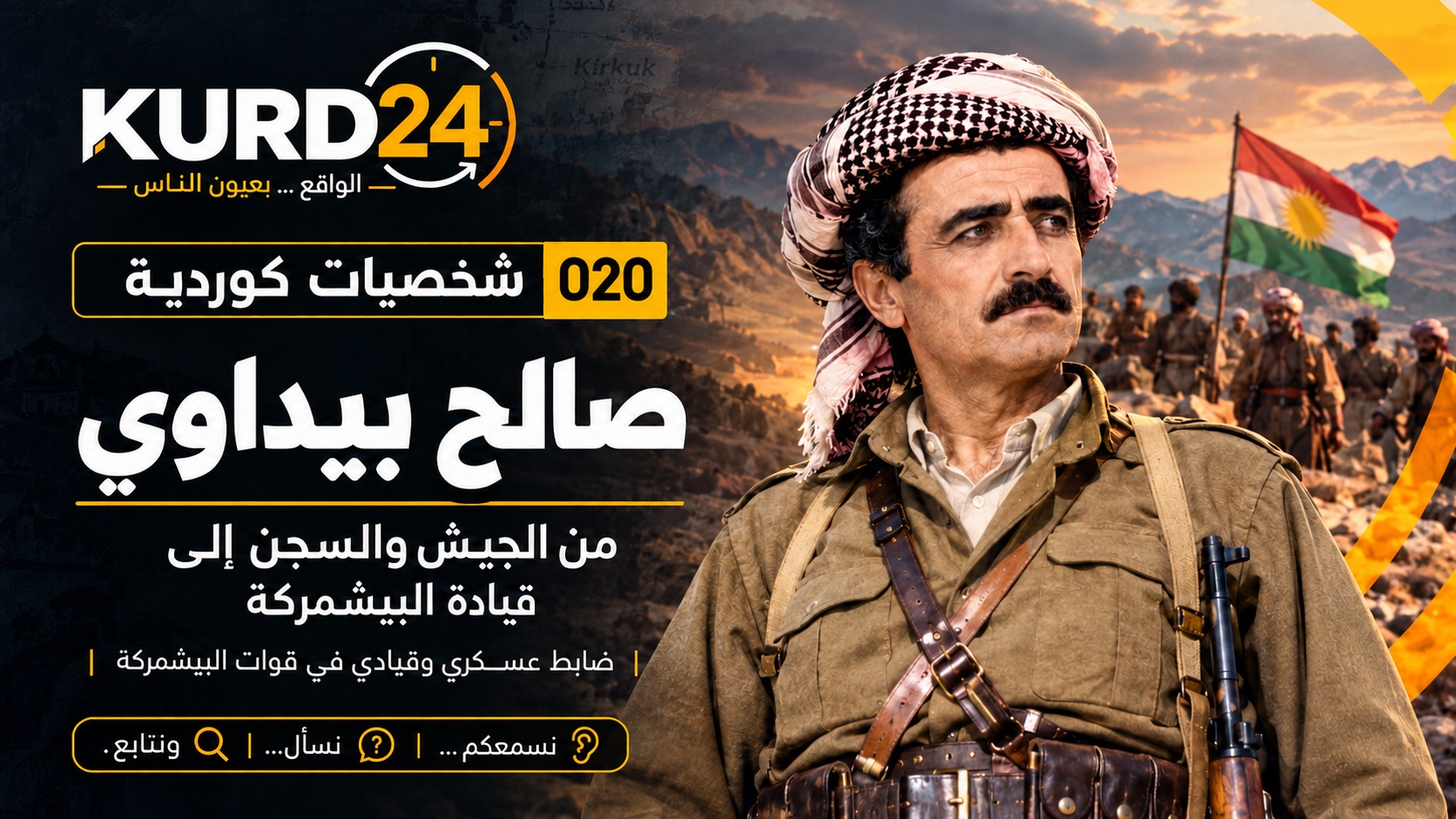
Basic information
- Name:Saleh Bidawi
- Adjective:A military officer and leader in the Peshmerga forces
- The most prominent period in his career:The sixties and seventies of the twentieth century
- The most prominent stations:Service in the Iraqi army, arrest and imprisonment, joining the September Revolution, commanding military units in Qardag and Kirkuk, then asylum and exile.
The biography provided to Kurd 24 describes Saleh Bidawi’s path from the Iraqi army to the Peshmerga forces. A published military certificate confirms that he was the commander of the Kirkuk Brigade in April 1974.
Who is Saleh Bidawi?
Saleh Bidawi’s biography represents an example of a Kurdish officer who moved between very different locations and experiences in a few years. He knew the Iraqi military institution from the inside, then lived the experience of detention, before becoming part of the armed Kurdish movement during the September Revolution. The sources place him among the Kurdish officers whose names are linked to the history of that revolution, and his name also appears in other historical sources dealing with officers and the Kurdish movement in Iraq. Therefore, his story is not limited to his personal biography, but also reflects an aspect of the political and military transformations that the Kurds experienced in Iraq during the sixties and seventies.
1963...the turning point
The year 1963 was one of the most influential years in Saleh Bidawi’s life. After the February 8 coup and the subsequent arrests and widespread political and military conflicts in Iraq, Bidawi was arrested and entered a long period of imprisonment. Sources related to his military biography mention that he was transferred to Nuqrat al-Salman prison, and that a death sentence was issued against him before it was later commuted. This stage was not just a passing incident, but rather became a dividing point between his previous life as an officer in the Iraqi army and the path he would take after his release from prison.
Years of imprisonment
Saleh Bidawi remained detained for several years. According to his biography published in the sources for the officers of the September Revolution, the sentence issued against him was changed after the political transformations that Iraq witnessed, before he was released in late 1966. Bidawi was released from prison after difficult years, but his life did not return to the path it was previously on. After only a short period, he made a decision that would place him at the heart of the armed Kurdish movement.
1967... Joining the September Revolution
In 1967, Saleh Bidawi joined the September Revolution and the Peshmerga forces. The revolution had begun in 1961, meaning that Bidawi was not one of the men in its first phase, but he entered it carrying military experience gained from his previous service in the army. This experience was important in a military environment that required officers capable of managing units, organizing forces, training, and planning field operations. From here began the most important chapter in his life.
1969... Regiment commander
Saleh Bidawi rose to military responsibilities within the revolutionary forces. By 1969, he became, according to his published biography: Commander of the BMW Regiment. Sources attribute to him participation in military confrontations during that stage, including operations in the Halabja region. With his assumption of command of a regiment, Bidawi was no longer just an officer who joined the revolution, but rather became part of the field command structure of its forces.
Agreement of March 11, 1970
On March 11, 1970, the Iraqi government and the Kurdish leadership reached a political agreement that established a framework for resolving the Kurdish issue and self-rule, and the relationship between the two parties entered a different stage from the previous years of fighting. During the arrangements that followed the agreement, Saleh Bidawi’s biography indicates his appointment: Commander of the First Regiment of the Border Guard. This was a remarkable station in his career. Within less than a decade, he had moved from serving in the Iraqi army to arrest and imprisonment, then to the ranks of the Peshmerga, before once again assuming military responsibility in the new circumstances that followed the 1970 agreement.
1973... Command of the Qardagh Brigade
Saleh Bidawi’s rise in the military structure continued. In 1973, according to his biography, he assumed command of the Qardagh Brigade. The Qardag region, south of Sulaymaniyah, was of military and geographical importance, especially with the renewed escalation of tension between the Iraqi government and the Kurdish leadership. This stage illustrates the major transformation that his life witnessed: Iraqi army officer → prisoner → Peshmerga officer → regiment commander → brigade commander.
1974... Leadership of the Kirkuk Brigade
With the advent of 1974, the conflict between the Iraqi government and the Kurdish movement entered a new phase of widespread military confrontation. At that stage, Saleh Bidawi reached one of the most prominent military responsibilities in his career: commanding the Kirkuk Brigade. The biography of Officer Beston Ahmed Najib Abdul Rahman Mufti provides an important witness to this stage. He remembered that on April 6, 1974, he joined the Kirkuk Brigade of the Peshmerga Forces, and that Lieutenant Colonel Saleh Bidawi was the commander of the Kirkuk Brigade, and he was the one who sent him two days later in an official letter to the headquarters of the Revolutionary Command in Nawbardan.
Another historical testimony about the formation of the Kirkuk forces also mentions the name: Saleh Bidawi - commander of the forces and places Aziz Qadi as deputy commander of the forces, which provides additional documentation of Bidawi’s leadership position at that stage.
The importance of Kirkuk
Kirkuk was not an ordinary military sector. The city and the surrounding region were linked to complex political, economic and national issues, in addition to its oil importance and geographical location. Therefore, assuming military responsibility in the Kirkuk sector placed Saleh Bidawi in an important position during the final stage of the September Revolution. Historical testimonies related to the organization of the Kirkuk forces show that Bidawi was part of the military leadership of this sector in the period preceding the events of 1975.
1975... the end of a phase
On March 6, 1975, Iraq and Iran signed the Algiers Agreement. The agreement and the resulting cessation of Iranian support for the Iraqi Kurdish movement led to a rapid change in the balance of power and the collapse of the armed phase of the September Revolution. For Saleh Bidawi, as for large numbers of fighters and leaders of the Kurdish movement, a new phase of asylum and exile began after that. This was the end of a chapter that spanned years of direct military action in the mountains of Kurdistan.
A march linked to the Kurdish issue
The name Saleh Bidawi was associated with a generation of Kurds who lived through a pivotal stage in the history of the Kurdish movement in Iraq, and chose to participate directly in its events and bear its consequences. During his career, he moved from serving as an officer in the Iraqi army to years of detention and imprisonment, before after his release he joined the September Revolution and rose through positions of military responsibility until he reached command of important units within the ranks of the Peshmerga. For his comrades and supporters of the movement to which he belonged, his career reflected a firm commitment to the Kurdish cause and defending the rights of the Kurdish people. This commitment was not limited to rhetoric or political positions, but was linked to practical stages that extended from prison to military action, then to asylum and exile.
This is why Saleh Bidawi’s biography is read as part of the memory of a generation that devoted many years of its life to what it considered defending the Kurdish cause and the rights of the Kurdish people, and in the process paid great personal prices.
From Kurdistan to exile
After the collapse of the September Revolution, the Kurdish movement itself entered a phase of reorganization, while many of its members and leaders found themselves distributed between Iran and other countries. As for Saleh Bidawi, he later ended up in the Netherlands. Thus, his life's journey extended through different places and experiences: the Iraqi army, prison, the mountains of Kurdistan, asylum, and then the Netherlands. It is a journey that reflects an aspect of the life of an entire generation that found itself amid the conflicts and transformations that Iraq and Kurdistan witnessed in the second half of the twentieth century.
Death...
The biography provided to Kurd 24 states that he died in the Netherlands and that his body was transported to his birthplace in the village of Bidah in 1999. We have no independent source available to confirm the date of his death.
A journey that summarizes an entire stage
Saleh Bidawi’s life cannot be reduced to one battle or one military position. It is a journey that began within the Iraqi army, then moved to prison, from prison to the ranks of the September Revolution, and from command of a regiment to command of a brigade, all the way to his responsibility in the Kirkuk forces during one of the most sensitive stages of the conflict. Then came the events of 1975, ending a whole chapter of his life and opening a chapter of asylum and exile. This is why his biography provides a window into a broader phase of the history of Iraq and Kurdistan. A stage in which the individual's life changed completely due to coups, wars, and political conflicts.
Why do we remember Saleh Bidawi?
Saleh Bidawi is mentioned among the Kurdish officers whose career was linked to the September Revolution, and sources confirm his leadership position in the Kirkuk forces during 1974. But the importance of his story goes beyond military rank. It is the story of a man who knew the army, prison, war, asylum, and exile, and his name remained associated with the Kurdish cause among his comrades and supporters of the movement to which he belonged. From a historical perspective, his experience represents an example of the path taken by a number of Kurdish officers who moved from serving within the Iraqi military establishment to joining the Peshmerga forces during the conflict between the Iraqi government and the Kurdish movement.
As for the memories of the supporters of that movement, Saleh Bidawi remains a member of a generation that saw defending the rights of the Kurdish people and their cause as worthy of years of sacrifice, work, and confrontation.