
Qazi Muhammad
History and politics
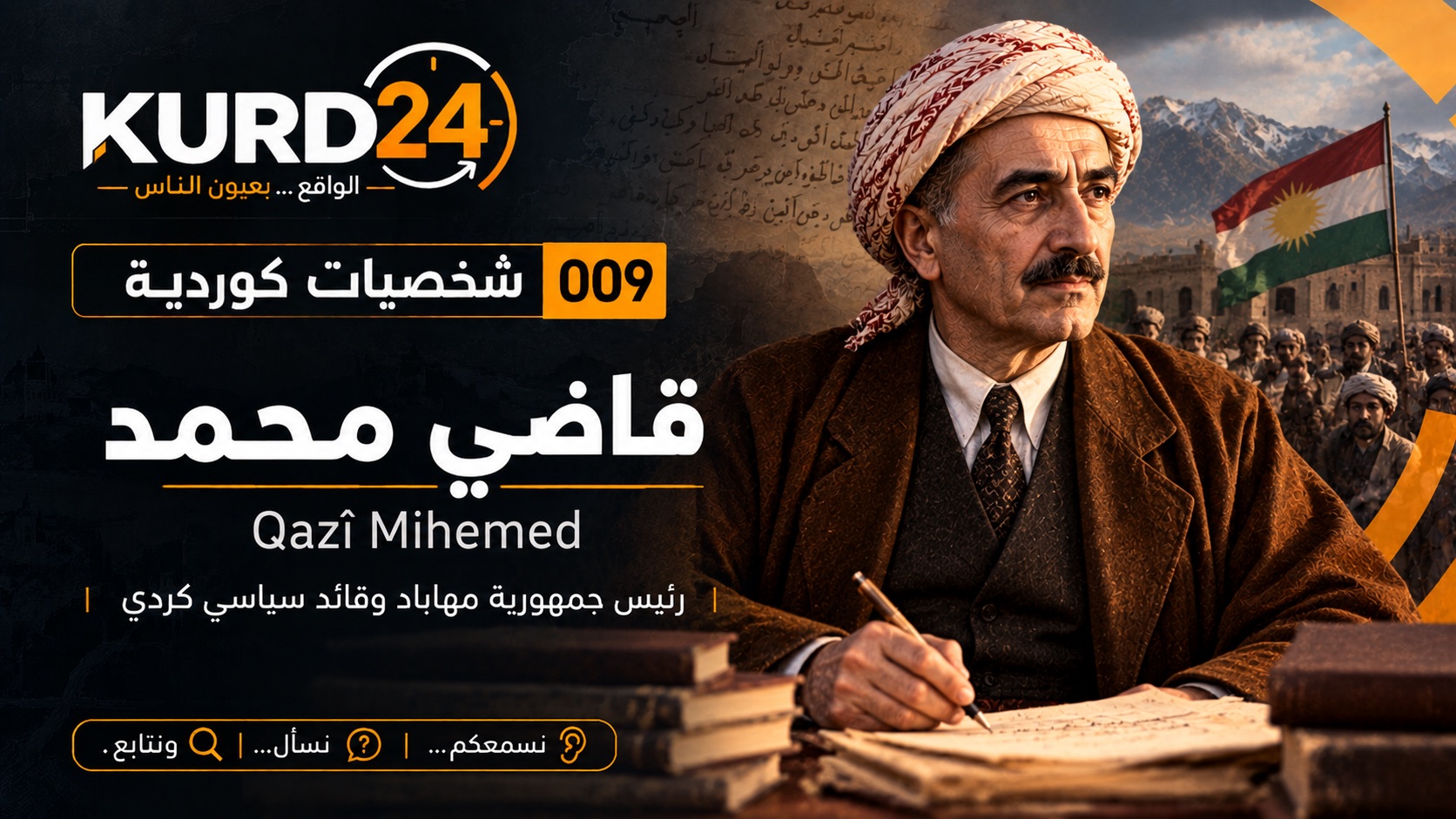
Basic information
- Name:Qazi Muhammad - Qazî Mihemed
- Birth:1893 – Mahabad, Iranian Kurdistan
- Death:March 31, 1947 – Mahabad
- Domain:Kurdish politics, judiciary, and leadership
- What he is most notable for:Presidency of the Kurdish Republic of Mahabad in 1946
Qazi Muhammad was one of the most prominent Kurdish political figures in Iran during the twentieth century. His name was associated with the establishment of the Kurdistan Democratic Party in Iran and the presidency of the Republic of Mahabad, which was declared in 1946.
Growing up and family
Qazi Muhammad was born in Mahabad in 1893, into a family of religious and judicial standing in the region. His father was Qazi Ali, and the title “Qadi” is linked to the family’s history in the judiciary and religious leadership. Encyclopaedia Iranica describes him as a judge and hereditary religious leader in Mahabad.
The circumstances in which he emerged
After British and Soviet forces entered Iran in 1941, political activity expanded in the north and northwest of the country. In these circumstances, a Kurdish political movement emerged in the Mahabad region, and Qazi Muhammad was one of its leaders.
Kurdistan Democratic Party
Encyclopaedia Iranica states that the Kurdistan Democratic Party of Iran was founded on August 16, 1945 by Qazi Muhammad. The party became the main political framework associated with the experience of the Mahabad Republic.
Declaration of the Republic of Mahabad
Encyclopaedia Iranica states that the public declaration of the republic took place on January 22, 1946, and Qazi Muhammad became its president. Another article in the encyclopedia records a preliminary step on December 15, 1945; Therefore, the starting dates differ in some narratives. Mahabad was the center of the republic, which lasted only a short period during 1946.
Qazi Muhammad and Mustafa Barzani
After Mustafa Barzani and his fighters arrived from Iraq, they linked up with the Republic of Mahabad and Barzani assumed a military role in it. The paths of the two men met in this political experience before their paths diverged after its downfall.
The relationship with the Soviet Union
The republic was locally Kurdish-led, and at the same time benefited from the conditions created by the Soviet presence in northwestern Iran. Encyclopaedia Iranica notes that the withdrawal of Soviet forces in the fall of 1946 deprived them of important military and economic support. The degree to which the Republic's decision was independent of Soviet policy remains a subject of historical debate.
The fall of the Republic
After the withdrawal of Soviet forces, the Republic faced internal disputes and difficulties with neighboring regions. In December 1946, Iranian forces regained control of the region and the experiment ended. Encyclopaedia Iranica states that Qazi Muhammad announced the surrender of Mahabad on December 15, 1946.
His arrest and execution
Qazi Muhammad remained in Mahabad after the Iranian forces entered, and then he was arrested and tried along with a number of the republic’s leaders, including his brother Sadr Qazi and his relative Saif Qazi. The three men were executed by hanging in Mahabad on March 31, 1947, according to an academic study archived at the University of Victoria. Stories differ about his motives for staying in the city, and it is not possible to be certain of any single reason.
Mustafa Barzani after Mahabad
Mustafa Barzani and a group of his fighters withdrew from the region after the fall of the Republic, and later arrived in the Soviet Union. Barzani lived there for years in exile before returning to Iraq in 1958, while Qazi Muhammad remained in Mahabad until his execution.
Why is his name still present?
Qadi Muhammad’s historical status is related to three main milestones: the founding of the Kurdistan Democratic Party in Iran in 1945, the presidency of the Republic of Mahabad in 1946, and then his execution after its fall in 1947. These events made him a key figure in the study of Kurdish political history in Iran during the twentieth century.