
Hassan Zirek
Music and singing
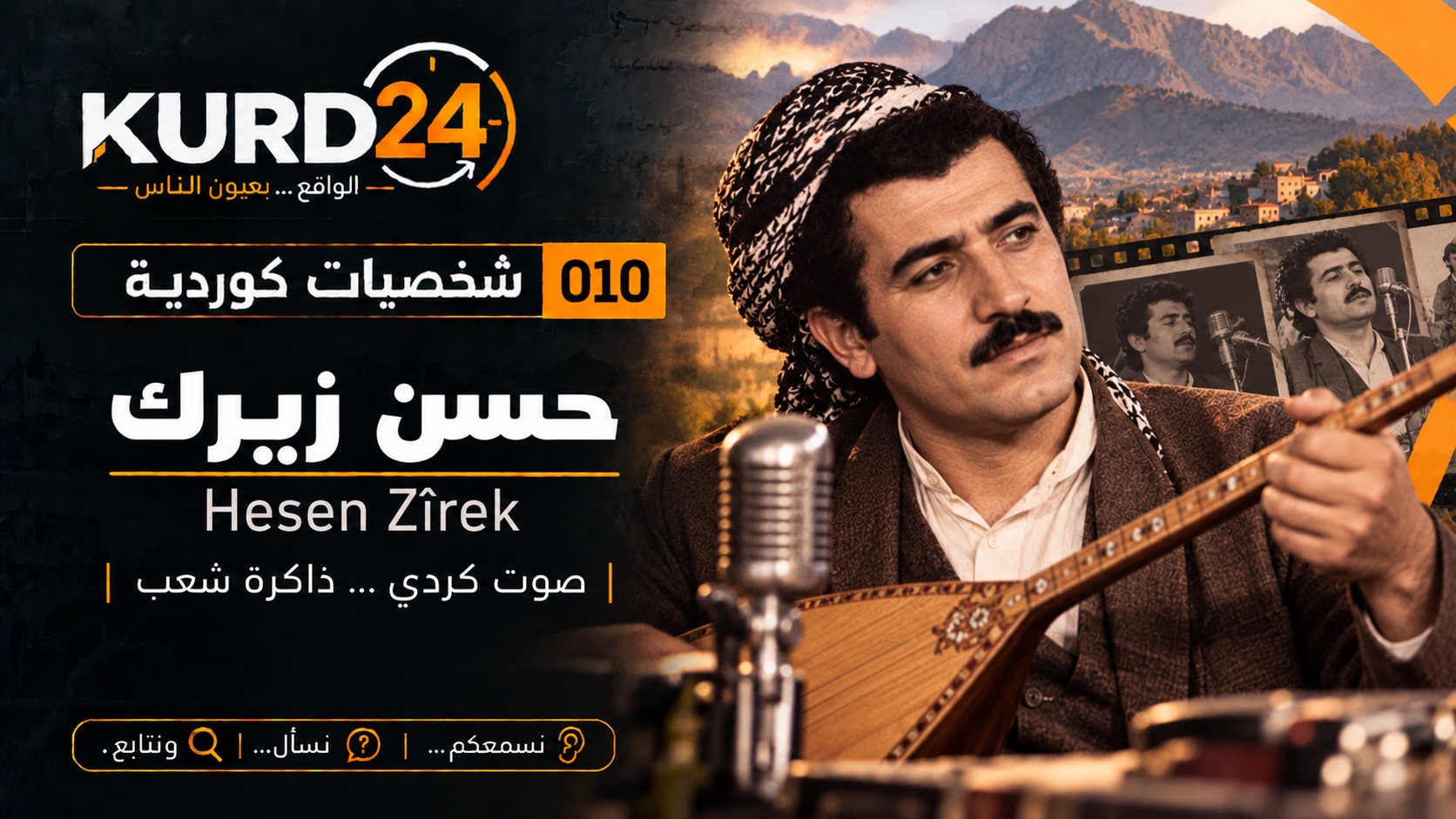
Basic information
- Name:Hassan Zîrek - Hesen Zîrek
- Birth:1921 – Bokan District, Iranian Kurdistan
- Death:June 26, 1972, according to a biography published in Al-Takahi newspaper
- Domain:Singing, composing, and musical heritage
- His primary singing language:Sorani Kurdish
- What he is most notable for:Recording the Kurdish popular song and publishing it on the radio
Who is Hassan Zirk?
Hasan Zirk was one of the most famous voices of Kurdish song in the twentieth century. He came out of a poor environment in the Bukan area, and relied on his talent for memorization, improvisation, and performance, then his voice reached a wide audience through radio and recording. It contributed to keeping part of the Kurdish folk singing heritage present among generations.
His birth and childhood
He was born in 1921 in the Bokan region of Iranian Kurdistan. He lost his father when he was young and had to work early and move between villages and cities in search of a livelihood. During these trips, he listened to popular songs and memorized many of their melodies and lyrics. Sources differ in determining his exact day and place of birth, so the year and region are sufficient here.
The talent of memorization and improvisation
He was known for his musical memory and ability to perform popular songs and re-present them in his own style. Not everything he sang was his personal composition; He performed popular folklore material, in addition to what he composed, composed, or reshaped. Therefore, a distinction should be made between his recorded credit and the works he wrote himself.
The trip to Baghdad
He arrived in Baghdad in the early 1950s, and began his professional radio career on the Kurdish section of Baghdad Radio around 1953, according to a music archive that published his recordings. Radio allowed him to reach listeners in multiple Kurdish regions outside his local area.
Radio recordings
He recorded many songs in Baghdad, and the works associated with his voice include “Cîwanî Cîwanî”, “Newroz Hatewa”, “Baran”, “Kermenşa Şarî Şîrine”, and “Reş Esmer”. These recordings became part of the Kurdish radio archive, and the songs began to be transmitted across borders by radio.
Return to Iran
He later returned to Iran and worked with Tehran and Kermanshah radio stations, and mentioned the biography of a Tabriz radio journalist as well. His experience combined folk singing carried from the villages and radio recording accompanied by more organized musicians and bands.
A sound that transcends boundaries
He sang mainly in Sorani Kurdish, and also performed songs in other languages. His repertoire varied between love, separation, nature, cities, Nowruz, songs of joy, and dancing. One of his most famous recordings is the Newroz song “Newroz Hatewa,” which remains present on Kurdish occasions.
How many songs did he leave?
Sources circulate different numbers for his credit, from hundreds of songs to about a thousand recordings or more. The count is affected by the multiplicity of radio versions, the presence of popular songs that were re-performed, and recordings that were not all preserved in the same way. Therefore, there is no reliable final number that can be said with certainty, but what is certain is that he left a large singing balance.
His last years and death
In his last years, he lived in difficult economic and health conditions, and a press biography mentions that he opened a small café near Bukan for a period of time. He died in 1972, and the biography published in the newspaper “Al-Takhi” dated June 26. He was buried in the Bukan area.
His musical legacy
His songs did not disappear after his passing; His recordings continued to be circulated and his works were re-performed on occasion. These recordings help researchers and listeners track the transmission of Kurdish song from councils and villages to the microphone, radio, and audio archives.
Why do we remember Hassan Zirk?
Because he carried Kurdish folk singing to a wide audience in the radio era, and left recordings with his voice that became part of the Kurdish musical memory in the twentieth century.