
Ahmad Khani
Literature and thought
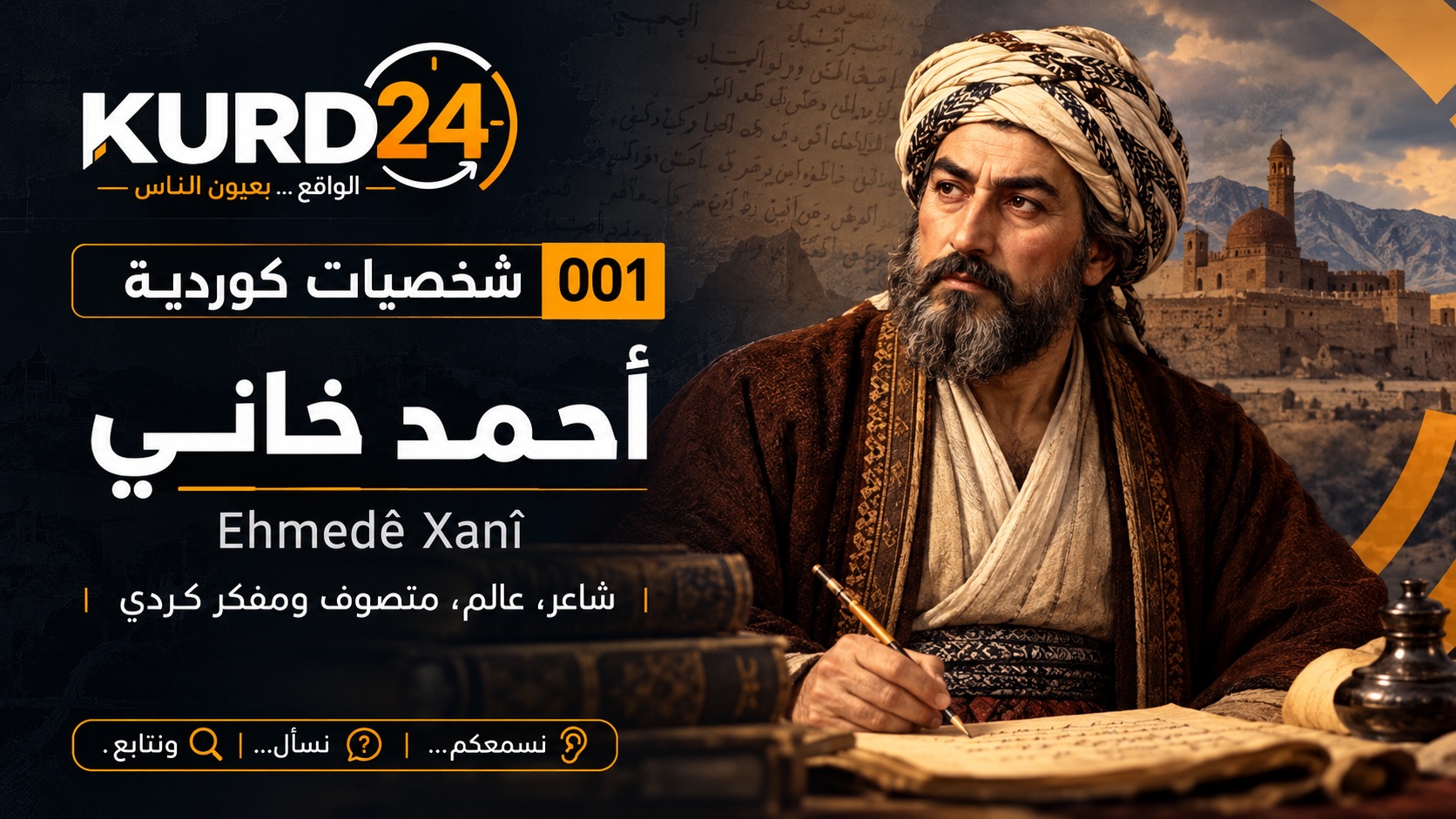
Basic information
- Name:Ahmed Khani - Ehmedê Xanî
- Birth:about 1650–1651
- Place of birth:Hakkari region
- Death:1707, according to the most famous sources
- Place of death:Bayezid - currently Dogubayezid
- Domain:Poetry, literature, thought, Sufism and education
- Basic literary language:Kurmanji Kurdish
- His most famous works:Mem û Zîn
Who is Ahmed Khani?
Ahmed Khani is considered one of the most prominent figures of classical Kurdish literature and thought, and one of the figures who left a long impact on the development of literature written in the Kurdish language.
Khanyi was not only a poet; He was a scholar, mystic, teacher, and thinker. He wrote about religion, language, and literature, and used Kurdish in educational, intellectual, and literary works at a time when Arabic and Persian enjoyed a wide place in education and culture in the region.
Encyclopaedia Iranica describes him as a prominent Kurdish poet, mystic, scholar, and thinker, and indicates that some researchers consider him one of the early figures in the development of Kurdish national thought.
Birth and upbringing
There are limited discrepancies in the sources regarding his year of birth.
Encyclopaedia Iranica places his life between 1650 and 1707, while the TDV Islamic Encyclopedia states that he was born in the year 1061 AH/1651 AD, and states that his father’s name was Ilyas. Therefore his year of birth is given here approximately: 1650–1651.
Sources link it to the Hakkari region. As for the surname “Khani”, TDV gives several possible explanations for its origin, including its connection to a village called Khan near Hakkari or to a clan or family with a close name; The sources do not conclusively suggest one explanation.
Education and its journeys
Ahmed Khani received his education in traditional religious schools, and moved to different regions to complete his educational attainment.
Sources mention that he studied Arabic, rhetoric, and religious sciences, and that he was also interested in astronomy. Iranica indicates the possibility of his traveling to Syria and Egypt, but it does not present this as a certainty, and travel to these two countries remains a possible narrative, not an established fact.
Evidence from his works indicates that he lived for a period on the island of Botan, which was an important center of the Kurdish emirate at that time, before later moving to Bayezid.
Why does it occupy an important place in Kurdish literature?
Khani’s importance comes from the fact that he made the Kurdish language a tool of expression in multiple fields: literature, education, religion and thought.
Encyclopaedia Iranica indicates that his works were taught in traditional Kurdish schools from his time until the 1930s, which is an indication of their continued educational and cultural presence for centuries after his death.
His most prominent works
1. Mem û Zîn
is Ahmed Khani's most famous work, and one of the most famous texts in classical Kurdish literature.
Khani based his work on an older popular Kurdish love story associated with the Memê Alan tradition, then reformulated it into a written literary work, adding mystical, philosophical, social and intellectual dimensions to it. Encyclopaedia Iranica describes the story of Memê Alan as one of the most famous stories of the Kurdish oral tradition, while Khani's written version has become one of the most famous works of classical Kurdish literature.
The story revolves around Mem and Zain, two lovers who are prevented by circumstances and intrigues from meeting.
Mem falls in love with Zain, but Bakr stands in their way, and the events end with the death of Mem and then Zein, turning the love story into a tragedy that carries, in Khani’s text, broader connotations than the emotional story alone. The TDV Encyclopedia states that Khanyi also included in the work his thoughts and observations on the social, administrative and cultural issues of his time.
References differ regarding the date of completion of the work. The TDV infers from the text that it was completed around 1693, while other references give a date of 1694. Accordingly, the work is generally dated to the 1690s.
2. Nûbihara Biçûkan
is a very important work to understand Khanyi’s educational side.
is an Arabic-Kurdish dictionary organized by Khani in a way that helps learners acquire vocabulary.
According to Encyclopaedia Iranica, Khani completed the work in 1683, and it includes about 950 Arabic words and their meanings in Kurdish, and the encyclopedia describes it as the first dictionary written in Kurdish.
The nature of this book reveals another side of Khani's personality: he did not only write for the literary elite, but also produced educational material in the Kurdish language.
3. The Doctrine of Faith – Eqîdeya Îmanê
A religious educational work organized in the Kurdish language.
According to Iranica, it consists of 73 couplets in which Khani explains the foundations of the Islamic faith in the Kurdish language.
This work, along with his other works, shows the breadth of his interests between literature, language, education, and religion.
4. Çarkûşe
Khani is also credited with multilingual poems; TDV states that the resulting work Çarkûşe includes quatrains in which Kurdish, Arabic, Persian, and Turkish are used, and deals with themes such as love, separation, and meeting.
As for some other books that were historically attributed to him, TDV indicates that the accuracy of their attribution to him has not been proven, and their attribution to him remains uncertain.
Ahmed Khani thought
Khani's literature cannot be separated from his religious, mystical, and social ideas.
In his writings, he dealt with issues of existence, morality, knowledge, and divine love, and was influenced by the Sufi and literary heritage that preceded him. TDV mentioned that he was influenced by poets and Sufis such as Jalal al-Din al-Rumi and Abd al-Rahman al-Jami.
At the same time, in Mem and Zein, he addressed the conditions of Kurdish society in his time and issues of power, division, and knowledge.
This is why modern researchers have read some of Khani's passages as an early expression of Kurdish national consciousness, and Encyclopaedia Iranica claims that some researchers consider it to be one of the intellectual beginnings of Kurdish nationalism. But this is a later scholarly characterization of his ideas, not an agreed upon historical title.
Khani and the Kurdish language
One of the most prominent features of Khani’s project is his choice to write in Kurdish in literary, educational, and religious works.
Femm and Zein presented a major literary work in Kurdish, and Nobahara Bjokan taught vocabulary, while the Doctrine of Faith presented religious topics in Kurdish.
Thus his name was linked to the history of the development of written Kurdish literature, especially classical literature in Kurmanji. Iranica notes that Mulla Jaziri contributed to laying the foundations of classical Kurdish literature, while Khani, through Mem and Zayn, made another major contribution to the development of written Kurdish literature.
Final years and death
At some point in his life, Khani moved to Bayezid, and sources state that he died there in 1707, although there are some historical reservations about the absolute accuracy of the date.
The mausoleum attributed to him is located in Dogubayezid, near the Palace of Ishak Pasha, and TDV states that it has become a popular place to visit.
Ahmed Khani’s legacy
Ahmed Khani’s influence did not end with his death.
His works were passed down between generations, studied in traditional schools, and Mem and Zain were reprinted and translated into different languages and dialects. The sources indicate translations or copies in Sorani, Arabic, Russian, and Turkish, which helped expand the presence of the work beyond its original readership.
The story of Mem and Zein also transcended the book itself, and became a prominent part of Kurdish literary and cultural memory.
Quick information
- Ahmed Khani lived more than three centuries ago.
- Written in Kurmanji Kurdish.
- He was a poet, mystic, scholar, and teacher, and his activity was not limited to literature.
- He wrote an organized Arabic-Kurdish dictionary that includes about 950 Arabic words with their meanings in Kurdish.
- He used Kurdish to explain religious topics in the Doctrine of Faith, which includes 73 couplets.
- His name was particularly associated with Mem and Zein, which became one of the most famous works in classical Kurdish literature.
- His works remained among the reading materials in traditional Kurdish schools until the twentieth century.
Why do we remember Ahmed Khani?
Because his impact went beyond writing a famous poetic story. Khani combined literature, language, education, thought, and mysticism, and used the Kurdish language to express issues of love, knowledge, religion, and society in the seventeenth century.
His works remained present after more than three centuries, especially Mem and Zain, which became one of the most prominent marks in the history of Kurdish literature.