
Mustafa Barzani
History and politics
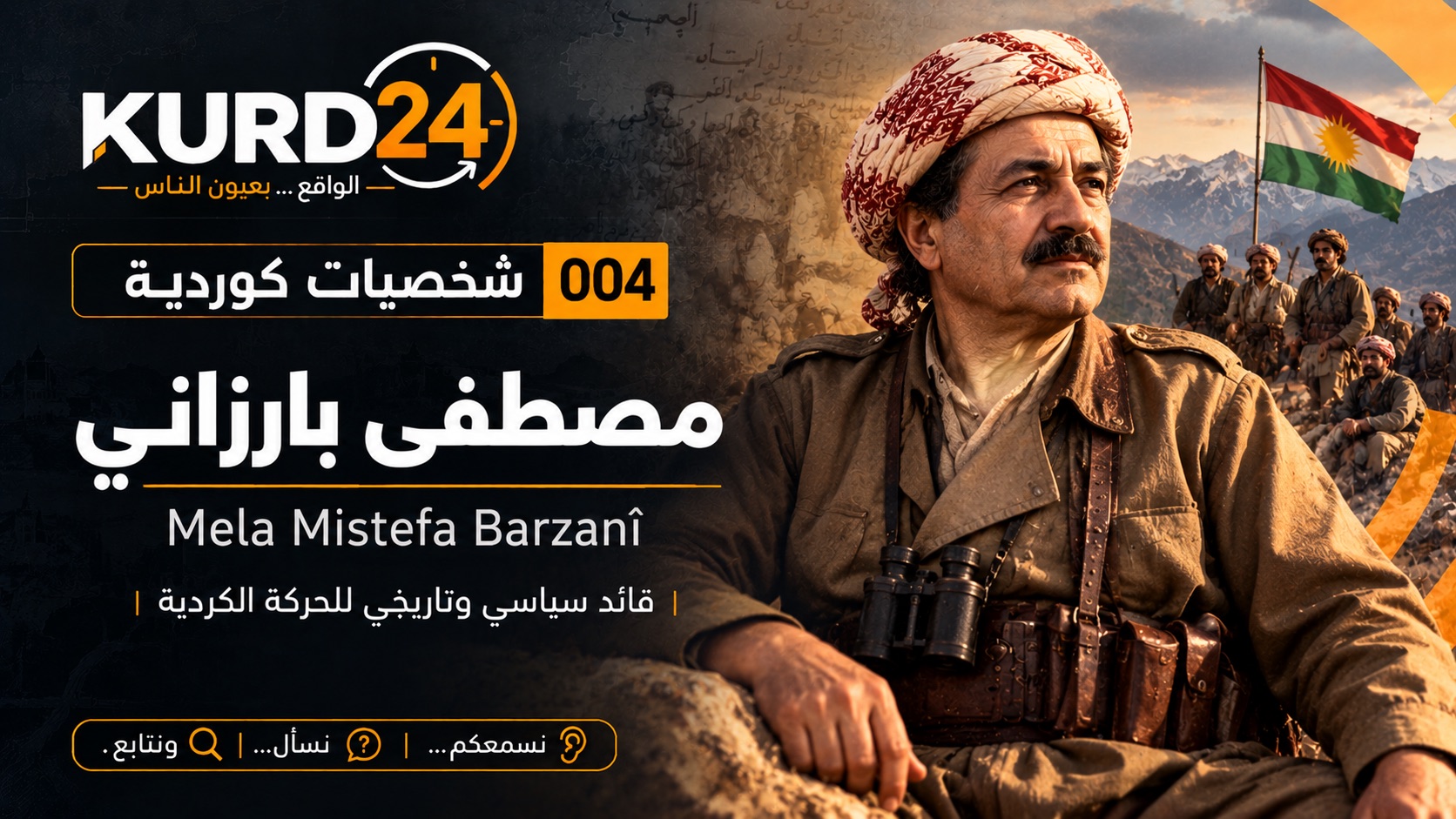
Basic information
- Name:Mustafa Barzani – Mela Mistefa Barzanî
- Birth:1903/1904 – Barzan, Iraqi Kurdistan
- Death:March 1, 1979 - United States
- Domain:Kurdish politics and leadership
- What he is most notable for:Leadership of the Kurdish movement in Iraq during the twentieth century
Mustafa Barzani is considered one of the most prominent leaders of the Kurdish movement in Iraq during the twentieth century, and he led the Kurdistan Democratic Party for many years. His biography is linked to political and military transformations that extended from Barzan and Mahabad to the autonomy agreement in 1970.
Growing up and Barzan
Mustafa Barzani grew up in Barzan, northern Iraq, within a family with a religious, social, and political presence. His older brother, Sheikh Ahmed Barzani, was one of the most prominent leaders of the region in the first half of the twentieth century.
Encyclopaedia Iranica gives his year of birth as 1904, while other sources give it as 1903. During the forties, he became increasingly prominent as a military and political leader. He returned with his brother to Barzan in 1943, and then entered into a confrontation with the Iraqi government after faltering demands related to services and rights in the Kurdish regions.
Republic of Mahabad
After his withdrawal from Iraq, Barzani headed with his forces to Iran, where he joined the Kurdish Republic of Mahabad, which was established in 1946. Encyclopaedia Iranica states that he became one of four generals in the republic’s forces. After its collapse at the end of the same year, its circumstances changed radically.
The march to the Soviet Union
After the collapse of the Mahabad Republic, Barzani and a group of his followers arrived in the Soviet Union after an arduous march, and then spent about twelve years in exile there.
Return to Iraq
The big shift came in 1958 when the Iraqi monarchy was overthrown. The revolution led by Abdul Karim Qassem allowed Barzani to return to Iraq after years of Soviet exile.
The first period witnessed a rapprochement between the new leadership and the Kurdish movement, but the relationship later deteriorated due to disagreements regarding the administration of the Kurdish regions and political rights.
September 1961 Revolution
By 1961, the dispute had turned into a widespread armed conflict between the Kurdish movement and the Iraqi government. Mustafa Barzani led the armed movement during this stage, and the confrontations continued, with periods of negotiation and change of Iraqi governments, until an important political agreement was reached in 1970.
Agreement of March 11, 1970
On March 11, 1970, the Iraqi government and the Kurdish leadership reached an agreement that stipulated granting the Kurds self-rule within Iraq according to arrangements that were supposed to be implemented later.
The agreement ended a nine-year war, but it did not end the dispute permanently; The following years witnessed disputes over its application, disputed territories, Arabization policies and other issues.
The year is 1975 and the end of a phase
The war returned, and the Kurdish movement was receiving external support in the context of the regional conflict between Iraq and Iran. In March 1975, the two countries reached the Algiers Agreement regarding their border disputes. Iranian support for the Kurdish movement ceased, leading to the collapse of the rebellion led by Barzani, who subsequently left for Iran.
This stage shows that the course of the Kurdish issue at that time was also affected by regional and international conflicts, in addition to the relationship between the Kurdish movement and the Iraqi government.
Final years and death
Mustafa Barzani did not return after the events of 1975 to lead a new armed movement inside Iraq. He later moved to the United States for treatment, and died in Washington on March 1, 1979.
Why is he considered an important figure in modern Kurdish history?
His career extends through key stations in the history of the Kurdish movement in the twentieth century: Barzan, the Republic of Mahabad, Soviet exile, the return to Iraq after the 1958 revolution, the September Revolution, the self-rule agreement in 1970, and then the events of 1975.
Encyclopaedia Iranica describes him as a leader whose influence was based on his military ability and on the support of, in addition to his tribal environment, rural and urban sectors, intellectuals, and members of the Kurdish middle class.